
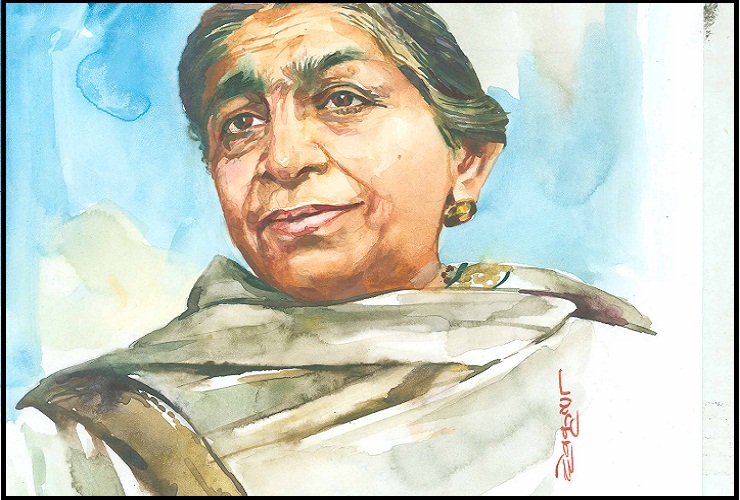
Nation building work is a noble work. Whatever work is done in the interest of the nation is less. The pages of history are colored with the stories of the heroes who sacrificed their lives for the nation. The glorious stories of sacrifice of women imbued with national sentiments make the history of our country proud. In the freedom struggle, women came out of the purdah, left the four walls of the house and jumped into the freedom struggle. Fought shoulder to shoulder with men. There is a long list of such brave women. We are going to tell about some of them.
Sarojini Naidu-
Born on 13 February 1879 in Hyderabad, Sarojini’s mother’s name was Varadasundari and father’s name was Aghornath Chattopadhyay. He inherited the talent of poetry writing from his parents. Due to her sweet voice, she was given the title of Nightingale of India. She was married to Govind Rajul Naidu. After coming in contact with Gopal Krishna Gokhale and Mahatma Gandhi, she started writing poems based on patriotism. His speeches were enthusiastic. He participated in the Congress session in 1910. She became the President of the Indian Congress in 1925. In 1930, he carried out Dandi March in the ‘Salt Break Movement’. He also participated in Gandhiji’s Quit India Movement in 1942. She also went to jail several times during the freedom struggle. She became the Governor of Uttar Pradesh in independent India. He died on 2 March 1949.
Begum Hazrat Mahal-
Begum Hazrat Mahal was the wife of Nawab Wajid Ali Shah of Awadh. In 1856, Dalhousie shut down the Nawab by accusing him of misrule and inaction and captured Awadh. The rebellion of the first war of independence had begun. Begum Hazrat Mahal gathered the feudal lords of Lucknow and nearby areas and fought against the British. These people liberated all the areas under Awadh except Lucknow from the British. She became the guardian of Nawab Wajid Ali by declaring his minor son Birjis as the Nawab of Awadh. But the revolutionaries lost courage as soon as Mughal emperor Bahadur Shah Zafar was imprisoned. The British once again gradually captured all the areas. Begum Hazrat Mahal went to Nepal with her son. And started living in Kathmandu. He died in 1874.
Rani Gidalu or Rani Gaidinliu-
He was born on 26 January 1915 in a village named Rangmai in Manipur. She is also called ‘Queen Lakshmi Bai of Nagaland’. At the young age of 13, she joined her cousin Jadonaga. Jadonaga wanted to remove the British from Manipur. He had started a movement called ‘Heraka’. But before the movement could succeed, Jadonaga was captured and sentenced to death. Now Gaidinliu took command of the movement. She was an expert in guerrilla warfare and weapon handling. There were four thousand Naga soldiers with them. In the eyes of the British, she was a dreaded leader. He was arrested at the age of 16. Despite many efforts of Nehru ji, he could not get his release. She was released after the country got independence. Thereafter he took up the work of upliftment and development of Naga people. He received ‘Tamrapatra Freedom Fighter Award’, ‘Padma Bhushan’ and Vivekananda Seva Award. He died on 17 February 1983 at the age of 78.
Rani Laxmibai-
Born on 19 November 1928 in Varanasi, Lakshmi Bai was the daughter of Moropant Tambe and Bhagirathi Sopre. Her name was Manikarnika Tambe. People also fondly called them Manu and Chhabili. She was married to Jhansi King Gangadhar Rao Newalkar. After marriage, her name was Lakshmi Bai. Gangadhar Rao died on 21 November 1953. Before his death he adopted Damodar Rao. The British did not consider Damodar as the heir of Jhansi. He captured the fort of Jhansi. Lakshmi Bai participated in the first freedom struggle to protect Jhansi. The British attacked Jhansi. The war lasted for eight days. Due to the betrayal of one of his own chieftains he had to leave the fort. British soldiers surrounded him near Kalpi. The injured queen kept fighting. The British retreated after being defeated by the queen. But due to being badly injured, the queen attained martyrdom.
Jhalkari Bai-
He was born on 22 November 1830 to Sadovar Singh and Jamuna Devi of Bhojla village of Jhansi. She belonged to Koli caste. His mother died in his childhood. The father raised them like boys. Pleased with her bravery, the villagers married her to Jhansi’s army leader Puran Kori. She was a lookalike of Lakshmi Bai. Impressed by his intelligence and efficiency, Lakshmi Bai gave him training in weapon handling and horse riding. Jhalkari Bai took the queen’s place in the battle to get the queen out of the Jhansi fort safely. Being a look-alike of the queen, she was able to confuse the British. Her husband was killed in this war. It is said that Jhalkari Bai survived and disguised herself as Lakshmi Bai to avenge the queen’s death and kill Hugh Rose. Where they were taken captive. He asked for death as punishment but Hugh Rose, impressed by his bravery, released him. Some historians say that she also attained martyrdom in that war.
Lakshmi Sehgal-
Lakshmi Sehgal, born on 24 October 1914, belonged to a traditional Tamil family. After completing her medical degree from Madras Medical College, she went to Singapore. There she joined the Azad Hind Fauj during the Second World War. She was influenced by freedom movements since her childhood. She had gone to Singapore as a doctor. In 1943, she became the first woman member of the Azad Hind Fauj and became the colonel of the army’s ‘Rani Jhansi Regiment’. But people know her as Captain Lakshmi Sehgal. She was married to Prem Sehgal. She could not accept the partition of India-Pakistan. He was awarded ‘Padma Vibhushan’ in 1998. He died on 23 July 2012.