
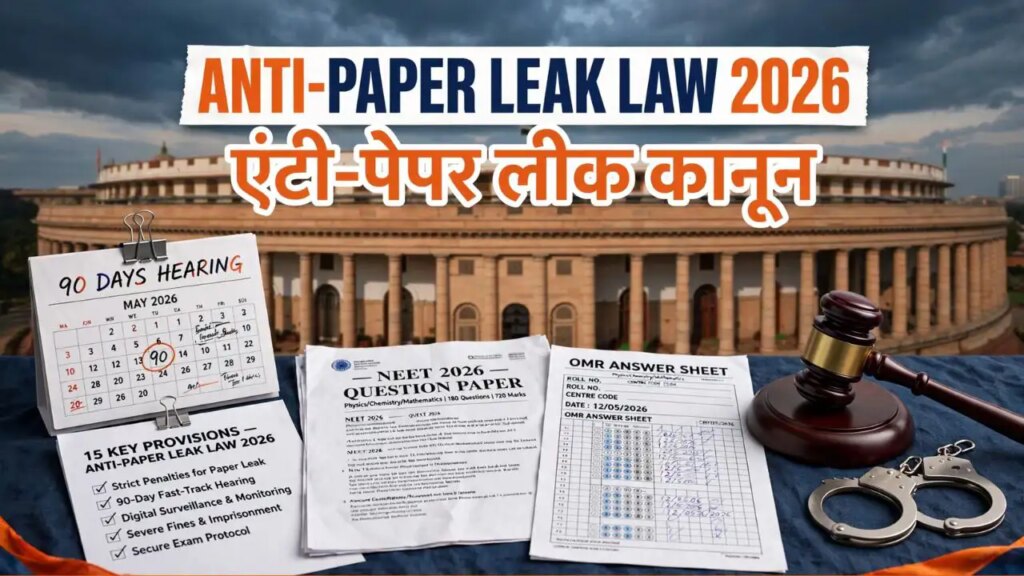
The fight over the paper leak issue has now reached Parliament from the streets. To strengthen the legal framework against paper leaks, the government has introduced ‘Anti-Paper Leak Bill’ in Parliament. Union Minister Jitendra Singh introduced this bill in the Lok Sabha. Following the recent protests at Jantar Mantar, the government has brought this bill in Parliament with stringent provisions to deal with paper leaks. Modi government has introduced this law to prevent paper leaks and irregularities in examinations. Under this proposed law, fast-track courts will be created in every state to hear paper leak cases; These courts will hold daily hearings, complete the trial within 90 days and pronounce the sentence.
Now there should be no attempt to divert attention from this issue. I appeal to the Congress and the Opposition to discuss the reforms brought by the government for the future of the students. This is not the time for politics. No excuses will be tolerated now. The bill brought for the students will be passed. “This is the government’s priority.” – Kiren Rijiju, Parliamentary Affairs Minister
What is the difference between the existing law and the new amendment bill?
Punishment: While the 2024 law earlier provided for a jail sentence of 3 to 5 years, the new amendment bill has increased it to 5 to 10 years.
Fine: The fine for paper leak, which was earlier fixed at ₹10 lakh under the 2024 law, will now be increased to ₹10 crore.
Investigating agency: Under the old law, a central investigating agency handled paper leak cases; However, the new amendment bill has mandated the formation of a special task force to investigate such cases.
Completion of investigation: The 2024 law did not specify any time limit for completing the investigation in paper leak cases, but the new amendment states that the investigation should be completed within two months.
Hearing: Under the old law, paper leak cases were heard in ordinary courts; After the amendment, these cases will be heard in fast-track courts.
Verdict: No time limit was set in the 2024 law for delivering the verdict in paper leak cases. On the contrary, there is a provision in the amendment bill to give the decision within three months.
Appeal in the High Court: In the old law, there was no time limit for appealing in the High Court in paper leak cases; Now appeal can be made within 30 days.
High Court’s decision: Under the 2024 Act, there was no fixed time limit for the High Court’s decision, but the amendment bill ensures that the High Court’s decision in such cases will come within three months.
PM Modi connected with the youth
PM Modi has been in constant touch with the youth on the issue of paper leak. In a video released on 23 July, he talked about bringing a new law to stop paper leaks and later on 24 July, thanked ‘Gen Z’ (the young generation) for their support. On July 26, he announced the creation of a high-powered task force. In his third video message, PM Modi formally announced the formation of this task force.
Formation of high-powered task force
PM Modi said in his video message that a six-member committee headed by Nandan Nilekani will give suggestions to the government on ways to stop paper leaks and ensure transparency in examinations. PM Modi stressed that the culprits of the paper leak will not be spared. He informed that fast-track courts have been created and the examination system will be made more transparent. The committee will advise the government on how technology can bring transparency in the examination system and strengthen public confidence in the examinations.
Prahlad Joshi took charge of the Education Ministry
After the protests at Jantar Mantar, Dharmendra Pradhan resigned and then PM Modi handed over the charge of the Education Ministry to Pralhad Joshi. This change in leadership comes at a time when India’s education system is undergoing major changes. The government is actively working to implement the National Education Policy (NEP) 2020 and launch a new school curriculum. The government hopes that Prahlad Joshi’s experience will give impetus to the ongoing reforms in the education sector. After assuming the post of Education Minister, Prahlad Joshi said that he will try his best to live up to the expectations of PM Modi.
What steps have been taken so far?
Taking strict action on the issue of paper leak, the government has dismissed 47 officials of the National Testing Agency (NTA). Criminal cases will also be registered against the dismissed officers. According to sources, this move is part of larger changes in NTA and more steps will be taken soon to reform the agency. On Thursday, the government transferred two secretaries in the Education Ministry. After this move, preparations are underway to change the outsourcing arrangement of NTA and implement technical improvements to ensure complete security of the examinations. Meanwhile, Delhi Police has formed a Special Task Force (STF) to investigate irregularities in the country’s prestigious examinations; This investigation will include all the major examinations conducted by UPSC to NTA. Many people accused in the paper leak case have been arrested and sent to jail.