
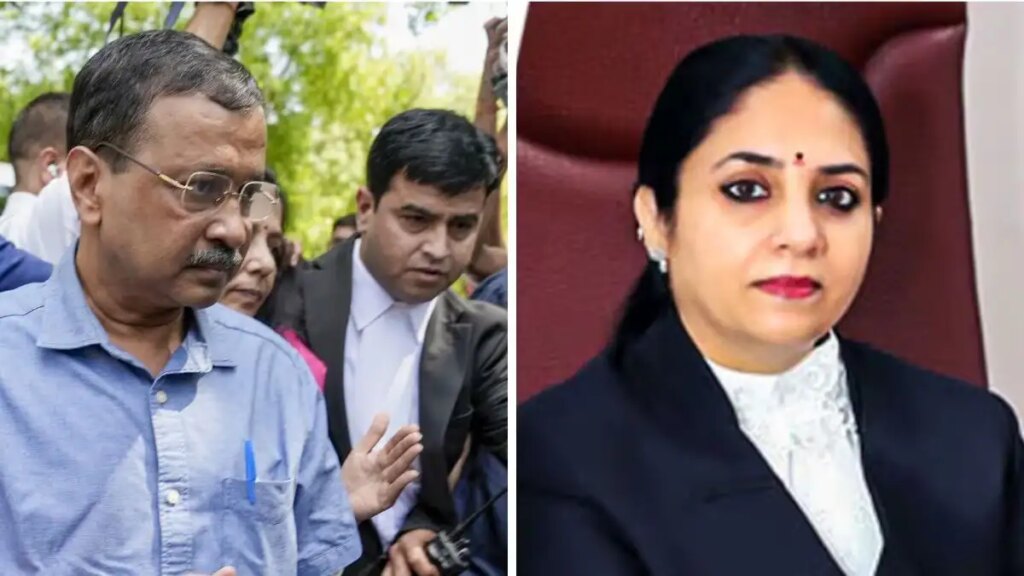
Arvind Kejriwal has once again demanded the removal of Justice Swarn Kanta Sharma from hearing this case. Justice Swarn Kanta Sharma is presiding over the hearing of the liquor scam case. On Wednesday, Kejriwal filed another affidavit in Justice Kanta’s court. In this affidavit, Kejriwal raised the issue that the judge’s two children work with Solicitor General Tushar Mehta. Kejriwal wrote: “Both the judge’s children work with Tushar Mehta. Tushar Mehta assigns cases to his children. Tushar Mehta is the lawyer appearing for CBI. Under these circumstances, how can Justice Swarn Kanta Sharma issue an order against Tushar Mehta?” Earlier, during the hearing on April 13, Kejriwal had said that Justice Sharma had on four separate occasions attended events organized by the ‘All India Advocates Council’—an organization linked to the Rashtriya Swayamsevak Sangh (RSS). As a result, he argued that he should be removed from the case.
On February 27, the trial court had acquitted Kejriwal and 22 other accused in the excise policy case. The CBI challenged this order, and the appeal is currently being heard by Justice Sharma. On March 9, Justice Sharma issued a notice and stayed the specific portion of the trial court order directing departmental action against the investigating officer.
He also found *prima facie* that certain observations made by the trial court were incorrect, and directed the trial court to adjourn the PMLA (money laundering) proceedings. Subsequently, Kejriwal, Manish Sisodia, Durgesh Pathak, Vijay Nair, Arun Pillai and Chanpreet Singh Rai filed a petition demanding Justice Sharma’s removal from the case.
April 13: Kejriwal’s 10 main arguments in court…
– During the hearing held on March 9, no one except the CBI was present. Without even hearing their arguments, the court declared the trial court’s order to be *prima facie* wrong. The trial court had given its verdict after a full day’s hearing, while the High Court considered it wrong after a hearing that lasted only five minutes. When this order was issued, I felt that this proceeding was moving towards bias. I wrote a letter to the Chief Justice, but it was rejected. Only after this I filed this application. - Initially, you said that statements of an ‘approver’ (an accused who has turned witness) can be considered. But here—after just a five-minute hearing—you said the trial court’s comments about the approver’s statements were wrong. This was of most concern to me.
– I want to rely on the decision given by this court in *Satyendra Jain vs ED* case. In that case, a bail hearing was underway; Six days of debate had already been completed, and this was the last scheduled date. Suddenly, the ED raised apprehensions over possible bias. The District Judge accepted this argument. After this the matter went to the High Court, where that objection was also upheld. There are a lot of similarities between that case and this case. In that case, the Court had said that the real issue was not the honesty of the judge, but the apprehension created in the mind of the litigant. My case is no different; Here too, the question is not about the honesty of the judge.
-The High Court also stayed the ongoing proceedings against the Investigating Officer (IO). The trial court’s observations were not against an institution like the CBI, but specifically against the IO. The IO had not sought any relief from the High Court, nor was he present there during the hearing. Yet, only at the behest of the CBI, proceedings against him were stayed. This creates doubt in my mind.
– In accordance with settled legal principles, stay of discharge order is imposed in very rare cases; Yet, in this case—without even giving us an opportunity to be heard—a portion of the order was stayed, and the remaining portion was substantially modified. It appears that, through this *ex parte* order, a substantial part of the trial court’s judgment has been set aside. I was not even given a copy of the CBI application.
– I note that the trial in this case—as well as the trial of other co-accused in this case, such as Manish Sisodia—is proceeding with extraordinary speed. Such speed is not seen in any other case. Both these cases are related to opposition leaders.
– In this court, almost every argument presented by CBI and ED is accepted. His every demand becomes, in effect, an order. Only one case (Arun Pillai case) proved to be an exception to this. Whenever ED or CBI makes a point, it is accepted, and an order is issued in their favor. In just four hours, the CBI filed a petition against the trial court’s lengthy verdict—a petition that lacked any solid basis. Yet, the order was passed ex parte during the very first hearing.
– Five cases have already come before this court. My own case was related to my arrest. Sanjay Singh, K. The bail petitions of Kavita and Aman Dhall were also heard here. The observations made by this Court in those cases, in themselves, amount to final decisions.
– There is an organization named ‘Advocate Parishad’, which is associated with RSS. You have attended its events on four separate occasions. We are completely against its ideology and openly condemn it. This matter in itself is of political nature. If a judge attends events associated with a particular ideology, this raises concerns about possible bias. As a result, this question arises in my mind: Will I get fair justice or not?
– An issue that is also being discussed on social media these days is that if people close to a judge are associated with any of the parties or their lawyers, then the judge usually recuses himself from that case. If a judge’s close associates have ties to one of the parties to the case, the judge recuses from that case. I humbly request that this aspect should also be considered.
February 27: Trial court acquitted 23 accused including Kejriwal.
On 27 February, while giving statement outside the trial court, Kejriwal had tears in his eyes. Manish Sisodia came forward and consoled him. On February 27, the trial court granted relief to all 23 accused in the case, including Kejriwal. The trial court also strongly criticized the CBI investigation in this case. Justice Swarn Kanta Sharma heard the CBI petition in which the trial court order was challenged. On March 9, he remarked that *prima facie* the trial court’s observations appeared to be wrong and their investigation was necessary.
Additionally, Justice Sharma’s court stayed the trial court’s recommendation to initiate departmental action against the CBI investigating officer.
Kejriwal spent 156 days in jail; Sisodia spent 530 days
In 2021, the Delhi government enacted an excise policy aimed at increasing revenue and improving liquor trade; However, this policy was later withdrawn due to allegations of irregularities.
Subsequently, Lieutenant Governor Vinay Saxena ordered a CBI inquiry into the matter. The CBI and the Enforcement Directorate (ED) allege that the policy was used to give undue advantage to private entities and involved corruption.
In connection with this case, Kejriwal was arrested and sent to custody during the 2024 Lok Sabha elections. The Supreme Court granted him bail after spending 156 days in custody. Meanwhile, Sisodia remained in jail for 530 days in connection with this case.