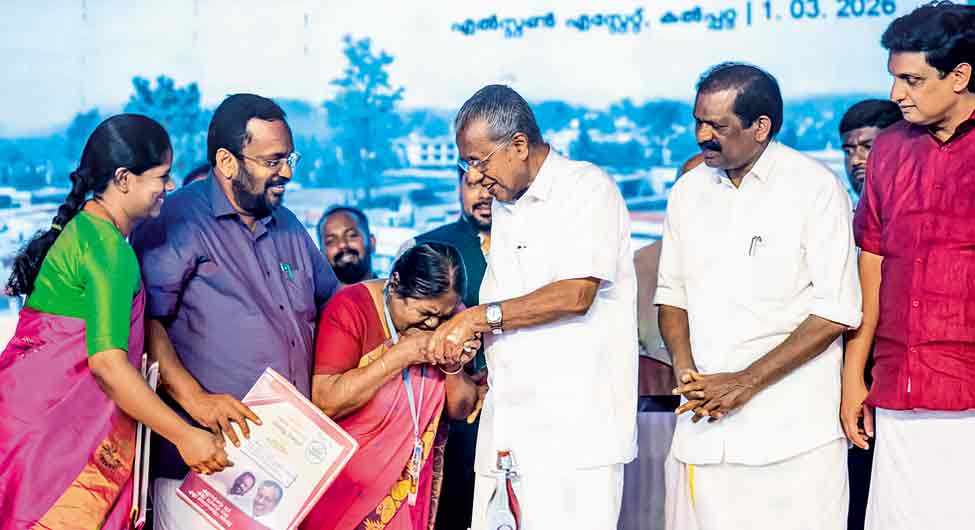
Victory is necessary for Congress, which has been out of power for a decade, important for Left parties to maintain their national relevance.
Kerala has elected 15 assemblies since the formation of the state and now voting for the 16th assembly will be held on April 9. The results will be out on May 4. These elections can also be very important politically, as the results can decide the direction of the social and political future of the state. For decades, politics here has revolved between two major alliances, the CPI(M)-led Left Democratic Front (LDF) and the Congress-led United Democratic Front (UDF). BJP has so far been able to win only one assembly seat in the state. However, with the continuously increasing vote share in the recent elections, the party and the NDA are hopeful that this time they will be able to break this cycle.
In Kerala, power has been alternating between LDF and UDF for decades, but in the last assembly elections, LDF broke this pattern by coming back to power under the leadership of Chief Minister Pinarayi Vijayan. Vijayan’s first term was full of many challenges. His first term coincided with two devastating floods in the state and the COVID-19 pandemic, which claimed thousands of lives. Many experts believe that the successful functioning of the government during those disasters helped LDF return to power. LDF currently has 95 MLAs and UDF 41 in the 140-member assembly. In 2016, LDF had 91 MLAs and UDF 41 and the NDA had one seat.
The victory in the last elections also helped the CPI(M) maintain its presence on the national stage after its crushing defeat in West Bengal and Tripura. The Left parties, which were once in power in three states, are now largely confined to Kerala. Therefore, for LDF, repeating the victory in the state is important to maintain political relevance at the national level.Is.
Former Congress state general secretary joins BJP
The stakes are equally high for Congress. The party desperately needs a win to maintain its prospects after being out of power in the state for a decade. In view of BJP’s aggressive efforts to expand its base, Congress insiders also believe that nothing less than victory will suffice to keep the party organization intact. Moreover, if Congress loses this time, some of its allies may scatter. In this, other parties including the influential Indian Union Muslim League may also be forced to think about their long standing alliance with the Congress. That means victory is a matter of life and death for both the major fronts for different reasons.
LDF’s challenges
Since assuming power, the central priority of the Pinarayi government has been grassroots development. According to his critics, the government is adopting a pragmatic approach by shying away from some core leftist commitments. Its emphasis is on infrastructure development and capital investment. So, the government is making its development record a major election issue.
But apart from this record of development, the LDF government is surrounded by many allegations and political challenges. These include the alleged involvement of party leaders in the theft of gold in Sabarimala, allegations of nepotism and claims of nexus between some police officers and the Sangh Parivar. Apart from this, the government has also been criticized for the functioning of the public health system. The government is also being attacked regarding higher education. Critics believe that the condition of higher education in the state is not good, which is why the youth of the state are migrating abroad for higher education. At the same time, organizational issues within the CPI(M) have also increased the pressure on the ruling front.
opposition’s bets
The election is being seen as a do-or-die battle for the Congress, not only in Kerala but also in terms of the party’s national position. From the decision of Rahul Gandhi and Priyanka to contest the Lok Sabha elections from Wayanad, it is understood that the Congress leadership is considering Kerala as an important political base. But the party is struggling with factionalism. Competition among effective leaders has exposed the lack of coordination within the organization. There is also huge pressure on the party regarding ticket distribution. Many senior leaders are putting pressure on tickets for their supporters. Former state president and MP K. Sudhakaran is particularly active.
Rahul in Puthugya Yatra
Despite these challenges, the Congress-led UDF seems full of confidence. This confidence is built on the landslide victory in the local body elections held in December. In those elections, apart from rural bodies, it had won most of the seats in many corporations. UDF leaders argue that these results are a sign of the emergence of anti-incumbency sentiment among the people.
Election surveys of different news channels have indicated that the contest is likely to be tough. Some political experts say that even though the anti-incumbency wave may not be very strong, boredom with the current regime is definitely visible among some sections of the voters.
What for NDA?
In Kerala, till now BJP had been able to win only Nemom assembly seat in 2016. But in 2021, the party could not retain this seat and CPI(M) snatched it back. However, since the Narendra Modi government came to power, BJP’s vote share has continuously increased in the Lok Sabha elections in the state. But the party has failed to win the assembly elections. This trend was seen in both the 2016 and 2021 elections. According to the 2024 Lok Sabha election data, BJP was ahead in about 11 assembly constituencies. The party managed to win the Thiruvananthapuram Municipal Corporation in the recently held local body elections, but its vote share reduced compared to the 2024 Lok Sabha elections. Nevertheless, this time the party is expected to win at least three to five seats.
main equation
Minority voters constitute about 48 percent of the total voters in Kerala and their role remains decisive in the politics of the state. Muslim voters have mainly been inclined towards UDF, one reason for which is the presence of ‘Indian Union Muslim League’.
Christian voters are another important category. A section of it was inclined towards the BJP to some extent during the Lok Sabha elections, especially in Central Kerala, but the results of the local body elections indicated that a large section of them may have returned to the UDF. The confidence of the opposition largely rests on this trend.
However, the outcome of the elections will depend on whether the LDF is able to sway anti-incumbency sentiments through the impact of its much-hyped development projects and welfare schemes. Whatever may be the results, whether Left Front or UDF wins, the politics of Kerala can change to a great extent and its reflection can be seen in the Center also.