
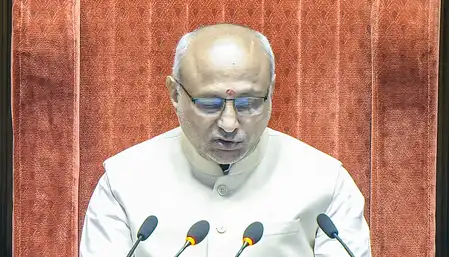
New Delhi, April 16 (IANS). Information about a historic achievement towards the country’s scientific progress and self-reliance was presented in Parliament on Thursday. Rajya Sabha Chairman CP Radhakrishnan told the House that India has achieved an important breakthrough in the field of nuclear energy on 6 April 2026 in Kalpakkam, Tamil Nadu. The country’s 500 MW prototype fast breeder reactor has achieved criticality for the first time. This means that a controlled and sustained nuclear chain reaction has successfully started in the reactor.
Briefing the House, he said that this is not just a technical achievement but the result of sustained efforts of thousands of personnel of scientists, engineers, industries and Department of Atomic Energy for more than two decades. This achievement not only strengthens India’s nuclear energy mission but is also an important step towards the goal of achieving net-zero emissions. It was told in the House that the core loading of this reactor was done in March 2024 in the presence of Prime Minister Narendra Modi. India’s nuclear policy is based on three phases, aimed at making maximum use of limited uranium resources and abundant thorium reserves.
In the first stage, plutonium is prepared through a pressurized heavy water reactor using natural uranium. In the second phase, more nuclear fuel will be produced from plutonium through a fast breeder reactor. The specialty of this technology is that it can generate more fuel than it consumes. Thorium based reactors will be developed in the third phase, which will ensure a long-term and sustainable energy future.
The House was also informed that through the Law on Nuclear Energy Sector passed in December 2025, the sector has been opened up for wider participation. The country is moving rapidly towards the target of 100 GW nuclear power generation. This reactor has been completely prepared with indigenous technology. It has been designed by the Indira Gandhi Atomic Research Centre, while the construction has been done by the Nuclear Power Corporation of India, in which Indian industries have had significant participation.
It is noteworthy that with this achievement of the country, India has joined the category of select countries which have mastered this advanced technology. It was described as a symbol of the country’s scientific capability, innovation and collective effort. The House said that this achievement is not only a major step towards energy self-reliance, but it also lays a strong foundation for India’s secure, sustainable and self-reliant future. The entire House expressed gratitude to all the scientists, engineers, technicians and all the stakeholders concerned for this historic success.
–IANS
gcb/sk