
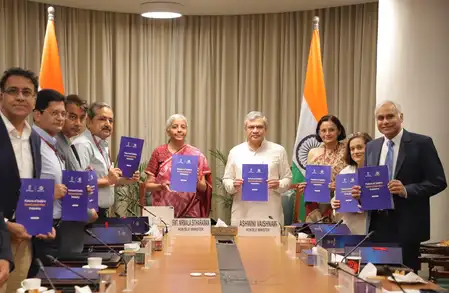
New Delhi, May 29 (IANS). NITI Aayog’s Frontier Tech Hub has released a big roadmap to strengthen India’s semiconductor industry. This 10-year roadmap titled “Future of India’s Semiconductor Industry” is designed to give India a strong position in the global semiconductor value chain.
On Friday, Union Finance and Corporate Affairs Minister Nirmala Sitharaman and Railways, Information and Broadcasting and Electronics and IT Minister Ashwini Vaishnav launched this roadmap. NITI Aayog Vice Chairman Ashok Kumar Lahiri was also present on this occasion.
Niti Aayog, in a post on social media platform This roadmap decides this direction.
The post further said that an ambitious target has been set for India in the roadmap, under which there is a plan to create a semiconductor ecosystem worth $ 120 to 150 billion in the country by 2035. It has identified opportunities in design, advanced packaging, compound semiconductors and other emerging areas.
NITI Aayog says that India is no longer limited to just creating the initial ecosystem, but has now entered the phase of deepening and strengthening this ecosystem.
NITI Aayog Vice Chairman Ashok Kumar Lahiri said that India has progressed faster than expected in creating a semiconductor ecosystem. However, technological self-reliance will be extremely important to achieve the goal of a developed India.
He said the biggest strategic risk facing India is increasing import dependence on ‘black-box technology’. In such a situation, technological sovereignty should start from the infrastructure level, where semiconductors form the backbone of critical industries like artificial intelligence, defence, manufacturing, mobility, energy, communications and digital services.
Lahiri further said that India cannot compete in the entire semiconductor value chain simultaneously. Therefore the country will have to work deeply on some strategic areas.
He said the roadmap recognizes that India needs to develop its strengths in areas such as design, advanced packaging and compound semiconductors where it can make a big leap in the global value chain.
Lahiri said India has gained strong momentum through semiconductor missions, early investments and growing partnerships with the US, Japan and Europe. Now the next 10 years will be crucial to convert this momentum into sustainable national capacity.
He said that this roadmap is not limited to strategy only, but special attention has been paid to its implementation. It identifies key priorities for the next decade, required policy support and areas where India can achieve global leadership.
–IANS
DBP