
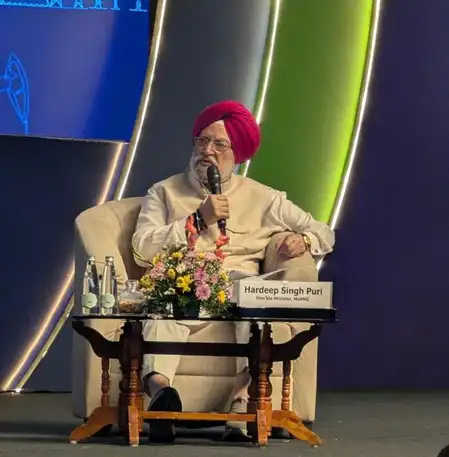
New Delhi, July 26 (IANS). Union Petroleum and Natural Gas Minister Hardeep Singh Puri on Sunday said transformative initiatives like Biofuel Mission, Green Hydrogen Mission and Samudra Manthan are taking India towards a new era of energy self-reliance.
The Union Minister said that biofuel is a strong foundation for India’s sustainable energy future. It empowers farmers, reduces dependence on imported fuel and provides a new impetus to environmental protection.
He said that in the next five years, India will emerge stronger as a global energy superpower on the strength of expansion of domestic energy production, absorption of new technologies and determination of ‘self-reliant India’.
The Union Minister said, “Under the visionary leadership of Prime Minister Narendra Modi, India is today moving rapidly towards energy transformation with full confidence.”
According to official data, the country has saved more than Rs 1.90 lakh crore in foreign exchange by replacing 310 lakh metric tonnes of imported crude oil with ethanol through the ethanol blending program in petrol from 2014-15 to May 2026. With this, farmers have received additional income of more than Rs 1.6 lakh crore and carbon emissions have reduced by more than 930 lakh metric tonnes.
The official statement said India imports about 88.5 percent of its crude oil consumption. This is why ethanol blending is one of the major priorities in the government policy. Every barrel of crude oil purchased from abroad makes India vulnerable to international price fluctuations and supply risks. At the same time, ethanol produced from sugarcane, maize and rice in India provides an effective option to reduce this dependence through domestic resources.
Additionally, India’s installed renewable energy capacity has increased almost four times to 288.58 GW by June 30, 2026, from 76.38 GW in 2014, according to information given by the government in Parliament last week.
The largest contributor to the country’s renewable energy capacity is solar energy, with an installed capacity of 162.15 GW. After this, wind energy is at 57.44 GW and hydropower is at 57.24 GW. The remaining 11.75 gigawatt capacity is of bio power.
Minister of State for New and Renewable Energy Shripad Yesso Naik said in a written reply to a question in the Rajya Sabha that by June 30, 2026, a total of 297.36 GW of non-fossil fuel based power capacity has been installed in the country. This includes 288.58 GW of renewable energy capacity and 8.78 GW of nuclear energy capacity.
–IANS
abs