
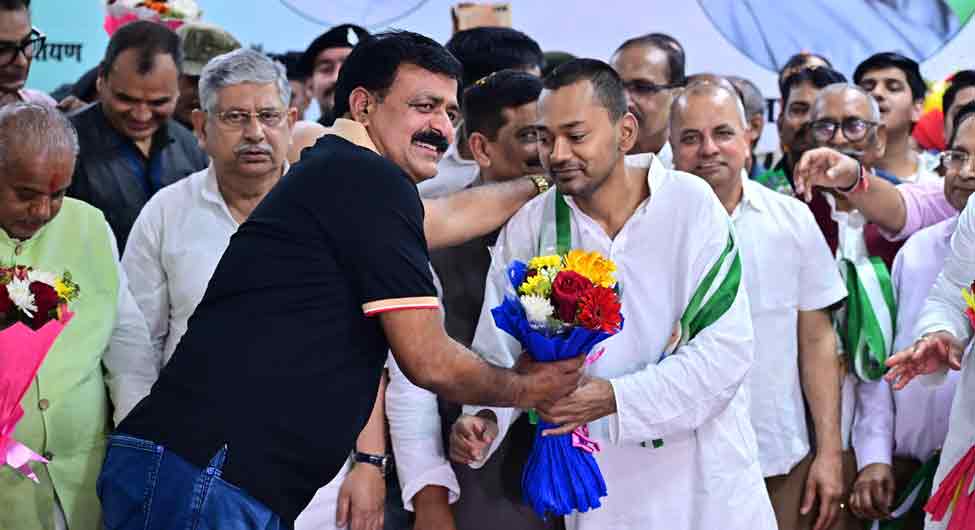
Politics cannot be done only on the basis of family legacy. One gets initial recognition from him, but ultimately everyone has to prove their worth. This will be the same challenge for Nitish Kumar’s son Nishant.
History is witness to the fact that Aurangzeb was more successful in politics than Dara Shikoh. Despite being representatives of the same heritage, the fate of different heirs in politics is not the same. Despite being from the same family, the political understanding and wisdom of two heirs may be opposite to each other. Some consider it their responsibility to carry the legacy of their family to the next generation, while for others, getting such a responsibility is no less than a burden. There are countless such examples from ancient times till today. Actually, politics cannot be done only on the basis of family legacy. It is easy to get initial recognition from him, but ultimately everyone has to prove his/her ability. In some, such ability becomes visible in the initial days itself, whereas in some, it is not achieved even after years of experience. Obviously, it is easy to enter politics with family legacy but it is difficult to create your own identity on your own.
The biggest example of this in Bihar politics can be seen in the family of Lalu Prasad Yadav. Despite having the same legacy, the political fortunes of Lalu’s two sons – Tejashwi Prasad Yadav and Tej Pratap Yadav – are diverging. Younger son Tejashwi is taking over the legacy of Rashtriya Janata Dal founded by his father, but elder son Tej Pratap is marginalized. Tejashwi emerged as his father’s successor and lived up to his expectations. Despite defeat in the last two assembly elections, Tejashwi has emerged as the strongest face of the opposition in Bihar. Certainly, if family legacy was the only criterion for success in politics, the status of Tejashwi and Tej Pratap would have been similar. Both of them entered political life together and became MLAs and ministers together, but Tejashwi’s political maturity was seen to be better than that of his brother, which cannot be seen merely by linking it to family heritage.
At present, all eyes in Bihar are on Chief Minister Nitish Kumar’s only son Nishant Kumar, who has recently joined his father’s party Janata Dal-United. There is talk that he may be given the post of Deputy Chief Minister in the next government. Some party leaders are even demanding to make him the Chief Minister. It is well known that Nishant has been reluctant to step into politics for years. The only reason for this has not been that his Lohiaite father has been staunchly opposed to promoting familyism in politics. The bigger reason is that despite his father being at the helm of power in the state for more than two decades, Nishant kept himself away from politics. There were reports that he was more interested in spirituality than politics. But suddenly one day the changed scenario brought him to the center of Bihar’s political stage, where he is expected to take his father’s legacy forward. Undoubtedly, this is not only a big responsibility for them but also a big challenge.
During his twenty-year tenure as Chief Minister, Nitish did remarkable work for the inclusive development of a backward state like Bihar, due to which he got the title of “Good Governance Babu” and “Development Man”. Personally, one of his biggest achievements during this period was that he did not allow any other member of his family including his son to enter politics. He continued to raise his voice against dynasty politics. In the last two decades, he remained the only universally accepted leader of his party. His entire party revolved around him. But, as has been the irony of every ‘one-man party’, the second generation leadership could not emerge in JDU. The biggest question before the party workers today is who will take over the leadership of the party after Nitish. Political experts generally believe that after Nitish, his party will disintegrate because there is no leader in his party who can keep the entire party firmly united. Perhaps this is the reason why Nishant has been brought into politics with the wish or reluctance of the Chief Minister. Party leaders hope that with Nishant’s entry into politics, the same unity will remain in the party as it remained during Nitish’s entire tenure. It will not be easy for Nishant to live up to such expectations, but the good thing is that he is making a completely new beginning in politics. Just have to remember that as Nitish’s son, he may have got the responsibility of handling a big legacy, but ultimately he will have to prove his capability among the public on his own.