
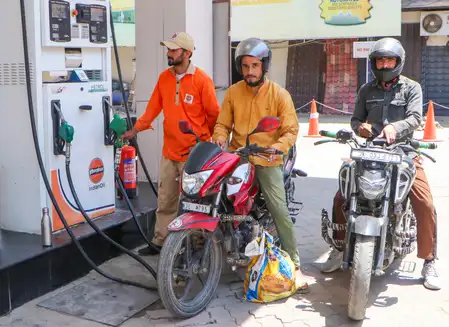
New Delhi, May 15 (IANS). The nominal increase of Rs 3 per liter in petrol and diesel prices by the government is nothing compared to the huge losses being incurred by the public sector oil companies. Crude oil prices in the global market have crossed $100 per barrel. A senior official gave this information on Friday.
The official said this modest increase reflects the government’s broader strategy to protect consumers from bearing the full impact of the global oil crisis.
According to sources, at present there is an under-recovery loss of about Rs 26 per liter on petrol and about Rs 82 on diesel. In such a situation, officials say that the increase of Rs 3 will be able to cover only a small part of the financial burden on state oil companies Indian Oil, BPCL and HPCL.
According to top sources, despite the sharp rise in global crude oil prices due to rising tensions in West Asia, government oil marketing companies and the central government are jointly incurring a loss of about Rs 1,000 crore every day to prevent a huge increase in the retail prices of petrol and diesel.
Sources said that the government’s message is clear that it does not want to put the entire burden of global crude oil inflation on Indian consumers.
Officials also said that a sharp increase in fuel prices will increase transportation costs, make food items costlier and hit household budgets, which could increase inflationary pressure in the economy.
The central government is also trying to protect the agriculture sector from global price shocks. Sources said that to provide relief to farmers, the government is already bearing the burden of fertilizer subsidy of about Rs 2.25 lakh crore.
Officials said the government’s current policy focuses on gradually reducing fuel consumption and increasing energy efficiency rather than suddenly increasing prices. According to sources, Prime Minister Narendra Modi is also emphasizing on reducing fuel consumption and reducing dependence on imports.
India’s increasing import bill is also a major cause for concern. Government sources described it as ‘double pressure’ caused by imports of oil and gold. India’s annual crude oil import bill is around Rs 12 to 15 lakh crore and every $10 increase in the price of crude oil adds an additional burden of around $13 to 14 billion to the country’s import bill.
Officials said the main reasons for the current oil crisis are US-Iran tensions and the impact on the Strait of Hormuz, through which about 20 percent of the world’s energy exports pass under normal circumstances.
“India has no control over these geopolitical developments,” a source said, “and the government deliberately does not want to put all the external pressure directly on consumers.”
Officials also said that India’s economic condition is much stronger now compared to the crisis period of 2012-13. The current account deficit is below 1.5 percent of GDP, whereas earlier it had reached around 5 percent. Also, despite global instability, inflation also remains under control at present.
Indian Oil officials said that to avoid any kind of fuel shortage, the company’s refineries are currently working round the clock at full capacity.
An official said that the country has crude oil reserves equal to 60 days’ requirement, which is sufficient as per the requirement of refineries. Therefore, at present there is no problem regarding fuel production.
–IANS
DBP