
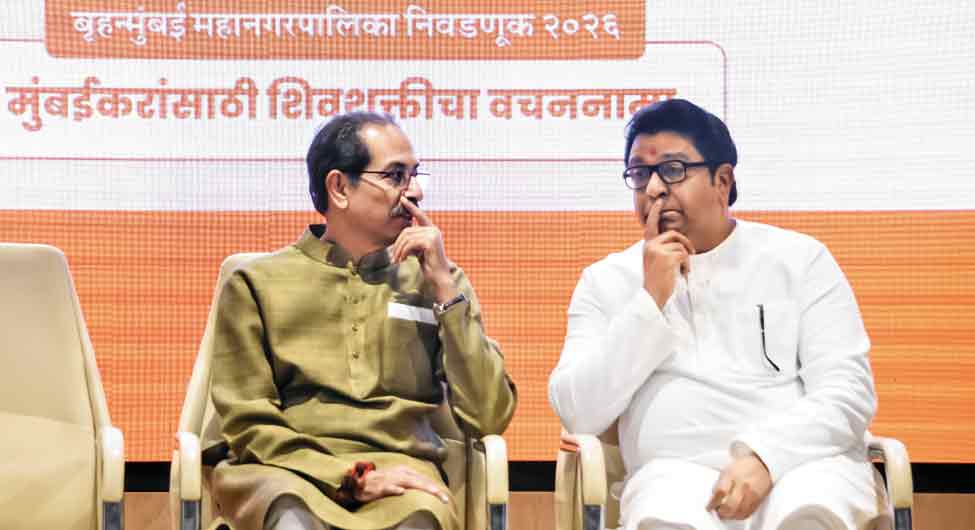
Raj and Uddhav Thackeray could not bring the results of local body elections in their favor, BJP formed an alliance with Shinde and gained power by taking both Marathi Manush and Shiv Sena in its favor.
The results of local body elections in Maharashtra have given a new and clear political verdict. Despite the Thackeray brothers coming on one stage, it did not make much difference to the voters, because Shinde Shiv Sena also got the votes of Marathi Manush’s politics. Because of this, perhaps for the first time such questions are being raised in the politics of Maharashtra, which were being postponed for a long time. If both the political heirs of Bal Thackeray together are not able to change the mandate, then is his legacy left? Bal Thackeray was not just the Shiv Sena chief but the party itself. His confession was undisputed. His relationship with almost every supporter was very personal. Under his leadership, Shiv Sena was less like a general political organization and more like a movement, centered around his strong voice and clear message. That voice resolved disputes, brought about reconciliation, enforced discipline and made the workers clearly aware of the ideology and hierarchy.
What Bal Thackeray created was very solid and unique. His leadership was completely personal. This established loyalty among the workers, but no structure was created with the help of which the party could move forward. This uniqueness of Shiv Sena made it a strong force, but now the same uniqueness is making its legacy weak.
However, inheriting power does not mean maintaining the same status. Uddhav Thackeray got the structure of the party and the weight of Thackeray’s legacy, but he naturally did not get the same name, election symbol and command of the party, which had once held the organization firmly together. Uddhav’s attempt to make Shiv Sena a more constitutional and power-oriented force may have weakened the aggressive commitment that was the basic foundation of the party. The cadre that thrived on blunt aggression found itself ideologically indecisive. The result was that the party still takes the name of Bal Thackeray, but no longer behaves like his Shiv Sena.
It is precisely this so-called ideological change that Eknath Shinde has used with devastating effect. Shinde has consistently argued that Uddhav abandoned Bal Thackeray’s aggressive Hindutva by forming an alliance with the Congress and Sharad Pawar’s NCP to remain in power. This claim became the moral basis of their 2022 rebellion, which was carried out with the heavy help of the BJP. In this way Uddhav lost the post of Chief Minister. Now Shinde is in power as Deputy Chief Minister under Devendra Fadnavis after the 2024 assembly elections and is presenting himself as the ideological successor to Bal Thackeray’s basic political ethos.
This difference says a lot. The title and identity remained with Uddhav, but he lost control over the organization and the original narrative. Shinde does not have the title and the family legacy, but he has managed to convince a large section of the Shiv Sena that he represents continuity rather than rupture.
In fact, while Uddhav represents the legitimacy of legacy, Raj Thackeray represents charisma. Raj inherited his uncle’s oratory skills, confrontational style and political understanding. Through the Maharashtra Navnirman Sena, he has kept alive the style of Bal Thackeray: aggression on the streets, anti-immigrant rhetoric and a strong claim on the ‘Marathi Manush’ vote bank. The recent corporation elections saw the repetition of old slogans, reminiscent of the 1960s, when Shiv Sena’s anti-outsider politics focused mostly on South Indians and not on migrants from Uttar Pradesh and Bihar.
Raj’s speech is largely based on the same old trend. His recent attack on BJP’s Tamil Nadu leader K Annamalai is a stark reminder of that period. He gave the slogan “Hatao Lungi, Bajao Pungi”. But the politics which this slogan is a mirror of is of a different Maharashtra. Even Bal Thackeray himself had long since moved on and become closely integrated into the larger Hindutva framework, with anti-immigrant politics serving only as a supplement rather than the main issue.
The more important story is different. Over the past decade, the BJP has adopted large parts of the Shiv Sena legacy more effectively than Bal Thackeray’s heirs. The BJP expanded Shiv Sena’s extreme nationalism, emphasis on cultural identity and disciplined organization. While Shiv Sena had once shown strength on the streets, the BJP has increased it on a larger scale.
By aligning with Shinde, BJP also achieved the issue on which Shiv Sena once had a monopoly, the fearless advocacy of Hindutva and Marathi Manush. By doing this, he squeezed Uddhav and Raj from both sides. BJP has occupied the ideological space towards which Bal Thackeray had gradually moved. Besides, BJP also has electoral numbers, organizational depth and access to power. On the contrary, Thackeray’s heirs are embroiled in the real-fake debate without any control.
In this background, the union of the Thackeray cousins was very powerful symbolically, but it could not translate into their strength in electoral results. There was an emotional connect with it for old Shiv Sena loyalists. The name Thackeray was a symbol of unity, leadership and undisputed Marathi political identity. But that feeling remained limited to identity, it did not translate into new loyalty or voting enthusiasm.
The results offer a larger lesson: Symbolism may garner applause, but credibility and strength get votes. What remains of Bal Thackeray’s legacy today is neither a united party nor an undisputed Marathi political force. What is left is symbolic capital, used over and over again and gradually losing value.
Uddhav and Raj may accuse the BJP of “fake Hindutva”, but their own weakness forces them to face a difficult question: What is the core ideology of their Shiv Sena now? Without numbers, organizational dominance, or a clear political path, the answer remains elusive.
This time the voter’s message is not dramatic, but decisive: heritage can be remembered, but not reused. Bal Thackeray molded the politics of Maharashtra in his own image. Others have learned to use that image more effectively than their heirs.