
The National Democratic Alliance (NDA) is heading towards setting a new milestone in the 2025 Bihar elections as it has crossed the 200 mark in the latest trends. The NDA, which had secured 206 seats in the 2010 elections, is set to touch the same figure once again as it is currently leading on 204 seats, while both the BJP and JD(U) have shown unexpected performances.
In the current trends, Nitish Kumar led NDA is leading in total 202 seats, followed by BJP in 92, JDU in 83, LJP in 20, HAM in 5 and RLM in 4 seats. This information has been received from the latest data of the Election Commission.
According to the Election Commission data, RJD is leading on 26 seats, Congress on 4 and overall Grand Alliance is leading on 35 seats. Apart from this, AIMIM is also leading on 5 seats.
For Nitish Kumar, who has been ruling the state for nearly two decades, this election is widely being seen as a test of both political stamina and public confidence.
The chief minister, once known as “good governance babu” for taking Bihar out of what was often described as “jungle raj”, has faced voter fatigue and questions over his changing political stance in recent years.
Despite this, current trends reflect a notable change at the grassroots level, indicating that voters are once again expressing confidence in his governance model.
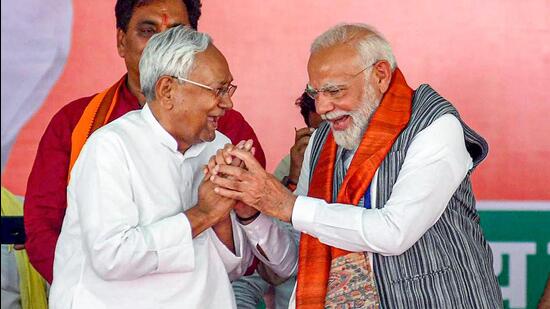
The return of a confident, coordinated BJP-JD(U) alliance has significantly changed the electoral battlefield this time. Prime Minister Modi stood firmly with Nitish Kumar throughout the election campaign, leading the alliance to present a united and rejuvenated front with an emphasis on welfare schemes, infrastructure expansion, social schemes and administrative stability.
The combination of Prime Minister Modi’s national appeal and the Bihar Chief Minister’s massive grassroots presence has created a formidable electoral force that looks set to translate its political momentum into a landslide victory in Bihar.
With the arrival of the mandate in Bihar, the Prime Minister Modi-Nitish partnership has emerged as a decisive factor in the assembly elections.
The ruling coalition has stressed that Bihar’s transformation is reflected not only in the election results but also in the conduct of elections. A comparative look at previous elections shows a dramatic change: the 1985 elections saw 63 deaths and re-polling in 156 polling stations; There were 87 deaths in 1990; In 1995, elections were postponed four times due to large-scale violence during the tenure of Chief Election Commissioner TN Seshan; And in 2005, re-polling was ordered at 660 polling stations.
In contrast, there was not a single re-polling and not a single violence in the 2025 elections, which the NDA has cited as evidence of better law and order.
These results have confirmed the pattern seen in several elections, with Bihar overwhelmingly supporting the BJP and Narendra Modi in the 2014, 2019 and 2024 Lok Sabha elections, as well as the 2020 and now 2025 assembly elections.
India’s third most populous state and with about 89 percent rural population, Bihar has long played an important role in shaping national politics. The NDA leadership has attributed the current mandate to the state’s strong rural support base and described it as Bihar’s “vote for respect and self-respect”.
The ruling party also accused the Indi alliance of disrespecting the state and cited comments made by its leaders, including Rahul Gandhi’s criticism of Chhath Puja. The NDA presented Prime Minister Modi’s effort to get Chhath Puja included in UNESCO’s intangible cultural heritage category as proof of his commitment to Bihar’s cultural identity.
Nitish Kumar, who is often targeted by the opposition by calling him ‘Paltu Ram’, has always kept his ground and vote bank strong. Nitish Kumar’s enduring popularity stems from his emphasis on sustainable development and inclusive growth.
He has fulfilled his promises, improved rural infrastructure and provided direct financial assistance, thereby earning everyone’s confidence in the socio-economic landscape of Bihar. Voters remember his kept promises and value steady progress over cosmetic rhetoric.
Nitish Kumar’s political journey spanning more than four decades has often been cited as an example of adaptability and strategic clarity. Emerging from the JP movement in the mid-1970s, he contested the Harnaut assembly seat in 1985 under the leadership of Satyendra Narayan Sinha of the Janata Party and emerged as a strong voice for backward castes and secular politics.
Nitish Kumar’s rule in Bihar has been characterized by a focus on development and inclusivity, which has helped him maintain popularity among all communities, including Muslims. His plans and policies have spurred economic growth, improved infrastructure and improved living standards, which has impressed voters.
Nitish Kumar’s political journey is a proof of his adaptability and strategic development. Influenced by stalwarts like Ram Manohar Lohia, SN Sinha, Karpoori Thakur and VP Singh, he honed his talent in the JP movement (1974–1977) with Jayaprakash Narayan. This experience brought him recognition among prominent politicians.