
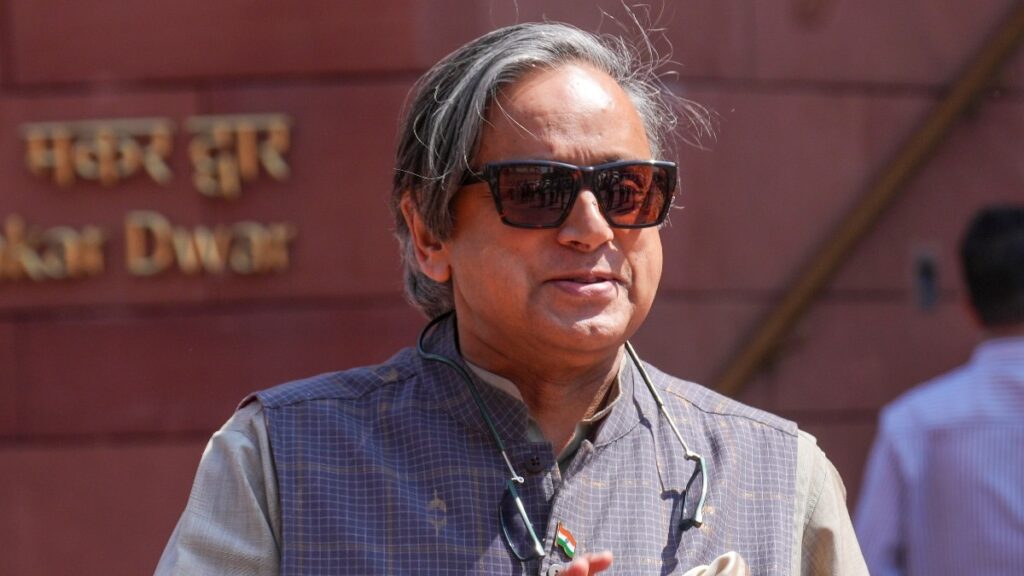
Congress MP Shashi Tharoor criticized dynastic politics in India, calling it a serious threat to democracy and said the time has come for the country to move towards meritocracy.
In an article titled ‘Indian politics is a family business’ on the Project Syndicate portal, Tharoor described “dynastic politics as a threat to Indian democracy” and argued that India should move towards “merit-based leadership”.
This idea can be seen as a dig at the Congress high command and its India alliance partners like Samajwadi Party (SP), Rashtriya Janata Dal (RJD) and Shiv Sena (UBT).
Tharoor said that after Lok Janshakti Party leader Ram Vilas Paswan, his son Chirag Paswan has been made the leader in NDA.
Now only two days are left for Bihar Assembly elections. Tharoor wrote that from India’s first Prime Minister Jawaharlal Nehru to Indira Gandhi and Rajiv Gandhi to current leaders Rahul Gandhi and MP Priyanka Gandhi Vadra, the idea that leadership can be a “birthright” in Indian politics has been strengthened.
He said, “For decades, one family has dominated Indian politics. The influence of the Nehru-Gandhi family, which includes the first Prime Minister of independent India.”
In a direct attack on the Congress, he said, “The political legacy of Prime Ministers Jawaharlal Nehru, Indira Gandhi and Rajiv Gandhi, and current opposition leader Rahul Gandhi and MP Priyanka Gandhi Vadra is linked to India’s freedom struggle history. But it has also cemented the idea that political leadership can be a birthright.”
He also hit out at Congress’ Bharat Bloc allies over dynastic politics, mentioning Shiv Sena (UBT) chief Uddhav Thackeray, his son Aditya Thackeray, Samajwadi Party chief Akhilesh Yadav, son of former Uttar Pradesh CM Mulayam Singh Yadav.
In Jammu and Kashmir, he pointed to three generations of Abdullahs and in Tamil Nadu, he highlighted that CM MK Stalin is the son of late Chief Minister M Karunanidhi, and said the family “controls” the ruling Dravida Munnetra Kazhagam (DMK) party.
Tharoor said that after Lok Janshakti Party leader Ram Vilas Paswan, his son Chirag Paswan has been made the leader in NDA.
He wrote, “Although the Nehru-Gandhi family is associated with the Indian National Congress, dynastic succession continues to prevail in the political landscape. Following the demise of Bijayananda (Biju) Patnaik, who was influential in the formation of the Janata Dal party, his son Naveen won the Lok Sabha seat vacated by his father. Naveen later founded the Diju Janata Dal in his father’s honor and followed in Biju’s footsteps by becoming Chief Minister of Odisha state, which he led for two decades.”
Maharashtra-based Shiv Sena founder Bal Thackeray handed over the reins of leadership to his son Uddhav, whose own son Aditya is apparently waiting for him. The same applies to Samajwadi Party founder Mulayam Singh Yadav, the former chief minister of Uttar Pradesh, whose son Akhilesh Yadav later served in the same position; Akhilesh is now an MP and the president of the party.
After Lok Janshakti Party leader Ram Vilas Paswan in Bihar state, his son Chirag Paswan took charge. He further said, “Beyond the Indian heartland, Jammu and Kashmir has been led by three generations of Abdullahs, while the main opposition party has been dominated by two generations of Muftis.”
“In Tamil Nadu, the family of the late M. Karunanidhi controls the ruling Dravida Munnetra Kazhagam party, with his son M.K. Stalin now chief minister and his grandson named as his successor,” Tharoor wrote.
The Lok Sabha MP from Thiruvananthapuram said political dynasties have a financial advantage over newcomers to politics.
He wrote, “Dynastic families usually have considerable financial capital, which they have accumulated over the years while in power. Additionally, they have access to a ready-made electoral machinery, including a network of donors, party workers and local goons. This gives them a huge edge over political newcomers.”
He said that “this sense of entitlement is so powerful that it can mask even a bad record, and enable dynastic leaders to remain at the top of their parties despite frequent electoral defeats.”
He said, “When political power is determined on the basis of lineage rather than merit, commitment or grassroots engagement, the quality of governance suffers. It is never beneficial to elect people with less talent, but it becomes especially problematic when the main qualification of the candidates is their surname.”
He stressed that “dynastic politics is a serious threat to Indian democracy.”
He concluded by saying that “the time has come for India to replace dynasticism with meritocracy,” and he called for reforms such as “meaningful internal party elections” and empowering voters to choose leaders based on merit.
He concluded, “This will require fundamental reforms, ranging from imposing legally mandated term limits to meaningful internal party elections, as well as concerted efforts to educate and empower voters to choose leaders based on merit. As long as Indian politics remains a family enterprise, democracy’s true promise of ‘government of the people, by the people, for the people’ cannot be fully realized.”
The BJP took the occasion to take a dig at the Congress and the Grand Alliance in Bihar, calling Rahul Gandhi and Tejashwi Yadav “children of nepotism”.
Sharing an ex-post, BJP spokesperson Shehzad Poonawalla praised Tharoor for his insights and wrote, “Very insightful article written by Dr Shashi Tharoor on how Indian politics has become a family business, he directly attacks India’s Napo Kid Rahul and Chota Napo Kid Tejashwi Yadav!”
This is the reason why famous tea vendors of Congress hate PM Modi.
Poonawalla further said, “I wonder what effect there will be on Dr. Tharoor for speaking so boldly. Dr. Tharoor has already been attacked for telling ‘the story of surrender’ on Operation Sindoor.”
Earlier, Congress leaders had questioned Tharoor over his praise of Prime Minister Narendra Modi and criticism of US President Donald Trump following the visit of Tharoor-led delegation to the US, Panama, Guyana, Brazil and Colombia following Operation Sindoor.
The Congress leader had said in an article that Prime Minister Modi’s “energy, dynamism and will to engage remains a major asset for India on the global stage, but it needs more support.”