
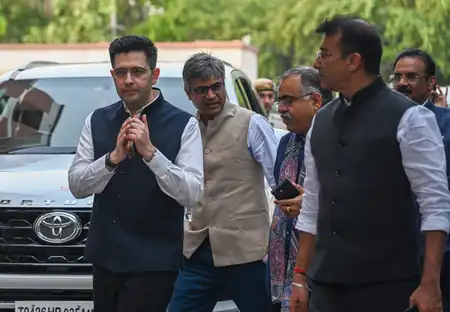
Ludhiana, June 22 (IANS). Rajya Sabha MP Raghav Chadha on Monday visited Punjab for the first time after quitting the Aam Aadmi Party in April and attended an important BJP meeting in Ludhiana. The purpose of this meeting, held under the chairmanship of BJP national president Nitin Naveen, was to make a strategy for the 2027 assembly elections.
Raghav Chadha attended this meeting along with another MP Rajinder Gupta, who had recently left AAP and joined BJP.
His presence in the meeting is being seen as an important political development. There are indications that he may be given some important responsibility in the organization before the elections.
According to party sources, BJP chief Nitin Naveen asked the leaders and MPs present in the meeting to work at the grassroots level. “Keeping in mind the 2027 elections, he made it clear that recently inducted MPs can be given important election-related responsibilities within the organisation,” a senior BJP leader who attended the meeting told IANS on condition of anonymity.
Apart from Raghav Chadha and Rajinder Gupta, five other AAP Rajya Sabha members Sandeep Pathak, Ashok Mittal, cricketer Harbhajan Singh, Swati Maliwal and Vikramjit Sahni had also announced to leave AAP and join BJP in April.
Except Swati Maliwal, the remaining six MPs represent Punjab in the Upper House (Rajya Sabha).
After leaving AAP, Raghav Chadha explained the reasons for his decision on social media. He alleged that the atmosphere of the party had become poisonous. Also, he said that joining the Bharatiya Janata Party will help him work better on the issues he supports.
Since seven out of 10 AAP Rajya Sabha MPs left the party en masse (which is two-thirds of the total), none of them were disqualified under the Tenth Schedule of the Constitution (commonly called the anti-defection law).
–IANS
amt/pm