
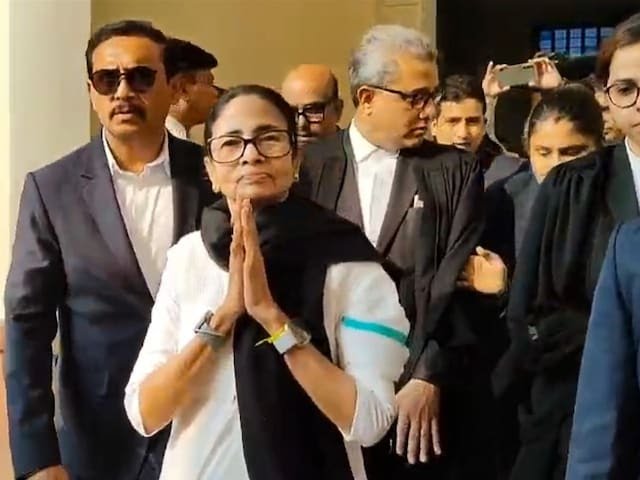
In a rare and unprecedented development, West Bengal Chief Minister Mamata Banerjee on Wednesday appeared in person before the Supreme Court of India and presented her stand alleging that the Special Intensive Revision (SIR) of voter lists by the Election Commission of India is being used to “target West Bengal” and remove genuine voters instead of removing errors.
Banerjee informed a bench headed by Chief Justice of India Surya Kant that the SIR exercise was being done only to exclude voters and not to include them.
He said, “This SIR is for deletion, not for inclusion,” and alleged that lakhs of voters have been wrongly marked under “logical anomalies”.
His plea, argued by senior advocate Shyam Diwan, points to alleged procedural lapses, including non-disclosure of reasons for classifying voters as non-compliant and rejection of valid documents by the Election Commission.
Banerjee’s counsel informed the court that names of 58 lakh voters have already been deleted and around 88 lakh voters have been marked, while around three lakh objections are still pending, while the final publication of the voter list is scheduled within 11 days.
Highlighting linguistic realities, Banerjee argued that different forms of common Bengali surnames like Dutta and Datta, Roy and Ray, Ganguly and Ganguli were being treated as mismatches.
As per his arguments, his legal team said that these were not spelling mistakes. These are differences in local dialects that occur throughout India.
Banerjee asked, “A daughter goes to her in-laws’ house after marriage and uses her husband’s surname. They (ECI) are deleting her name. Is this a reason to delete her name?”
Questioning the timing of the process, he said the Election Commission is conducting the SIR during festivals and harvest seasons when many voters are out of home.
He asked, “What was the rush to do this at such a time?” He alleged that West Bengal as well as other opposition (non-BJP ruled) states were being selectively targeted.
He further said, “Why only West Bengal, why not Assam?”, emphasizing that the Election Commission was selectively targeting only non-BJP ruled states.
However, the court assured protection to genuine voters, saying, “We will ensure that no innocent citizen is deprived,” Chief Justice Surya Kant remarked.
The Chief Justice further said that minor spelling or dialect differences cannot be grounds for exclusion. The bench clarified that the names of dead or ineligible persons will have to be removed as per law.
“The names of dead persons or ineligible voters, for whatever reason, have to be removed,” the court said.
On the issue of Aadhaar cards, which was raised by the Chief Minister on the grounds that they were not being accepted despite court directions, the court said it could not comment on it as the question of validity of Aadhaar as a citizenship document was pending before it and orders in this regard were reserved.
The Chief Justice said, “Aadhaar has its own limitations. We have reserved our decision on this issue.”
Senior advocate Rakesh Dwivedi, appearing for the Commission, said that the reasons for the discrepancies had already been stated in the notices issued during the SIR. He also said that the Commission has not yet received the new complaints raised during the hearing.
“These new complaints have not been made available to us. We need time to investigate them,” Dwivedi told the court.
Chief Minister Banerjee raised another issue in the Special Intensive Review (SIR) process, alleging that the Election Commission of India (ECI) is “not allowing state offices to participate in the process”. He claimed that instead, the Commission has “appointed micro-observers in BJP-ruled states” and is “using AI to remove names of voters”.
Refuting the allegations, senior advocate Dwivedi, appearing for the Election Commission, said the Commission was “forced to appoint micro observers” due to non-cooperation from the state government. “We have written several letters to the state government requesting it to appoint BLOs and other officers,” he told the court.
Dwivedi said the state government has provided “only around 80 officers”, leaving district level officers to handle the entire process. “I am under pressure,” he said, adding that “it is the state government’s fault for not providing the officer.”
Taking note of all the submissions, the Supreme Court issued notice to the Election Commission seeking its response on Banerjee’s plea and said the matter would be heard again on Monday, and the Commission would be given time to examine the new complaints highlighted by the petitioners.
The court was hearing a group of petitioners, including West Bengal Chief Minister Mamata Banerjee and AITC MP Derek O’Brien, who had filed petitions challenging the SIR (Special Information and Registration Order) made by the Election Commission of voter lists in West Bengal.
Earlier, due to allegations of procedural irregularities by the petitioners, the Supreme Court had issued several directions to the Election Commission, including specifically publishing the names of individuals.
This has been classified as a “logical anomaly” list, which may lead to removal of the name from the electoral roll. It is noteworthy that today Banerjee herself appeared in the court and presented arguments on her behalf.