
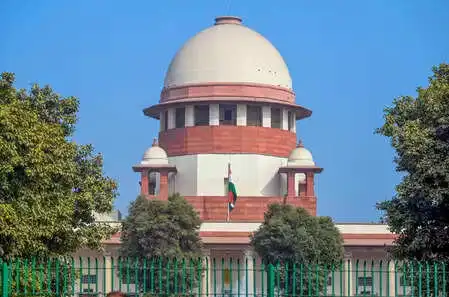
New Delhi, May 27 (IANS). The Supreme Court is scheduled to deliver a key verdict on Wednesday on a series of petitions challenging the Election Commission of India’s (ECI) move to conduct ‘Special Intensive Revision’ (SIR) of voter lists.
A bench of Chief Justice (CJI) Surya Kant and Justice Joymalya Bagchi will pronounce its verdict on Wednesday. After a long hearing in this case, the bench had reserved its decision earlier this year.
In these petitions, the validity of the SIR process initiated by the Election Commission has been challenged. The petitioners argue that this amendment process goes beyond the powers given to the Election Commission under Article 326 of the Constitution, the Representation of the People Act, 1950 and the rules made thereunder.
This controversy is mainly related to the condition of the Election Commission, under which the voters who were left out of the voter list of the year 2002 (or 2003 in some states) will now have to prove their citizenship. For this, they will have to prove their ancestral relationship with a person whose name was registered in the voter list at that time.
It was argued before the Supreme Court on behalf of the petitioners that this condition could lead to genuine voters being disenfranchised, especially those from marginalized and migrant communities, who may not have available documentary evidence linking their genealogy to the old voter lists.
During the hearing, the Supreme Court issued several interim directions, aimed at enhancing transparency and mitigating the hardships faced by voters affected by the SIR process in various states and union territories.
The Election Commission had initially identified 11 documents for verification. However, later the Supreme Court directed to also include ‘Aadhaar’ as an additional document for the SIR process.
Most of these petitions were filed in June last year when the Election Commission decided to start the SIR process in Bihar.
After this, the process was expanded to many other states and union territories including West Bengal, Kerala and Tamil Nadu.
The Election Commission defended this process before the Supreme Court, arguing that the main objective of this amendment is to ensure the accuracy of the voter lists and to prevent any duplication or inclusion of names of ineligible voters.
After hearing the arguments of both the sides in detail, the bench headed by Chief Justice Surya Kant had reserved its decision on January 29.
–IANS
SCH/AS