
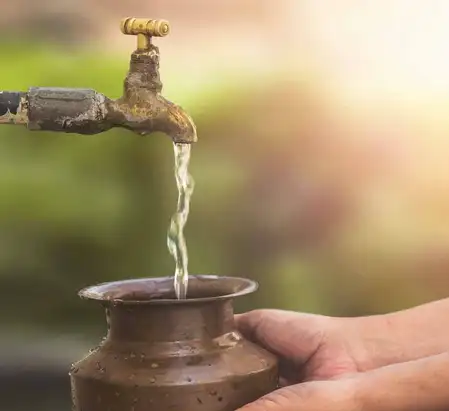
New Delhi, March 10 (IANS). The Union Cabinet chaired by Prime Minister Narendra Modi on Tuesday approved the proposal to extend the Jal Jeevan Mission till December 2028 and make changes in its format. Now the focus of this mission will not be limited only to creating infrastructure, but emphasis will also be laid on effectively providing clean drinking water service to every household in rural areas.
Under the restructuring of this scheme, the government has increased the total budget to Rs 8.69 lakh crore. The Central Government’s assistance in this will be Rs 3.59 lakh crore, which is much more than the earlier sanctioned Rs 2.08 lakh crore in 2019-20. That means the Central Government’s share has been increased by an additional Rs 1.51 lakh crore.
A national digital framework ‘Sujalam Bharat’ will also be implemented under the scheme. Under this, every village will be given a unique ‘Sujal Gaon’ or service area ID, through which the entire water supply system from the water source to the house will be digitally mapped. To ensure transparency and accountability, Gram Panchayats (GP) and Village Water and Sanitation Committees (VWSC) will be involved in the implementation and formal transfer of the scheme, which will be accomplished under the ‘Jal Arpan’ process.
Before declaring any Gram Panchayat as ‘Har Ghar Jal’, it will have to certify that adequate arrangements for operation and maintenance of water supply system in the village have been made by the State Government. The government believes that community participation and ownership are essential for the success of this scheme. For this purpose, there is also a proposal to organize ‘Jal Utsav’ every year, in which the people of the village will together review and maintain the water system.
At the time of launch of this scheme in the year 2019, only 3.23 crore rural households (about 17 percent) had tap water facility. Since then, tap water has been provided to more than 12.56 crore new rural houses. At present, out of 19.36 crore rural houses in the country, tap water connection is available in about 15.80 crore houses (81.61 percent).
According to the government, the impact of Jal Jeevan Mission has not been limited to the availability of water only. Its positive results have emerged in the assessments of many national and international institutions. According to SBI Research, due to this scheme, about 9 crore women have got relief from the daily labor of fetching water, due to which they are now able to participate in other economic activities.
According to World Health Organization (WHO) estimates, this scheme is saving about 55 million hours of women’s labor every day. Also, about 4 lakh deaths due to diarrhea can be prevented and about 1.4 crore Disability Adjusted Life Years (DALY) can be saved.
According to Nobel laureate Professor Michael Kramer, this scheme can reduce the mortality rate of children under five years of age by about 30 percent, saving the lives of about 1.36 lakh children every year. According to the study by IIM Bangalore and International Labor Organization (ILO), this mission is likely to create 59.9 lakh direct and 2.2 crore indirect employment opportunities.
According to the government, under JJM 2.0, all gram panchayats will be certified as ‘Har Ghar Jal’ by providing tap water to all 19.36 crore rural households in the country by December 2028. Also, separate agreements will be made with states and union territories, so that the schemes can be completed on time and water services can be made more effective for the citizens.
The government says that Jal Jeevan Mission 2.0 will not focus only on infrastructure, but will be developed as a citizen-centric service model. Its objective is to ensure 24-hour safe drinking water supply in rural areas under the goal of ‘Developed India 2047’.
Further, the Central Government will also work with various Ministries and Departments on a coordinated strategy for long-term operation, maintenance of rural water supply infrastructure and conservation of water sources, so that drinking water supply in rural areas becomes sustainable and reliable.
–IANS
DBP/