
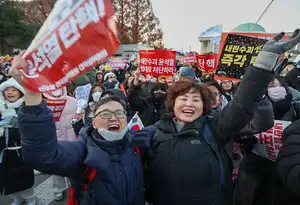
Seoul, February 21 (IANS). There is political uproar in South Korea over not giving death sentence to former President Yoon Suk Yeol. Some people even took to the streets while others termed the uproar as baseless. The question being asked is why death penalty was not given?
On Thursday (February 19), Yeol was sentenced to life in prison for failing to declare martial law in December 2024 as a rebel. When he received the sentence, hundreds of his opponents outside the court cheered, but the atmosphere soon changed to one of disappointment and anger. That’s because the demand was for death penalty.
No one has been given death sentence in this country after 1997. This was the reason why the court announced the maximum punishment. The local media, quoting various institutions and political figures, termed it as not correct.
South Korean human rights groups, civic groups, labor unions and political parties also issued statements expressing disappointment. Many people also took to the streets and protested. Critics said that during the political crisis, he tried to put pressure on democratic institutions by taking help of the army and security apparatus. For this reason, opposition parties and civil organizations accused him of “weakening the constitutional system”.
According to The Korea Times, Democratic Party of Korea (DPK) leader Jang Chung-rye said the decision is a “clear retreat” from the citizen movement seeking to block martial law in December 2024.
Yoon Suk Yeol is the former President of South Korea. Serious allegations were leveled against him regarding misuse of power and use of extraordinary powers like emergency.
Some protesters and victim groups believed that if a leader is proven guilty of endangering democracy, he should be given the harshest punishment so that no one can abuse power in the future. This is why when the court did not give him death penalty, there was disappointment and anger in a section.
However, it is important to understand that the death penalty still exists legally in South Korea, but no one has been executed since 1997. That means, practically, “Moratorium” (unannounced ban) is in force in the country. Courts often consider a punishment like life imprisonment more appropriate, even when the case is political.
Military dictator Chun Doo-hwan was sentenced to death in 1996 for leading a coup in 1979 and the subsequent massacre in Gwangju. His sentence was reduced to life imprisonment on appeal. He was then pardoned and released in 1997. He remained free until his death in 2021.
In closing arguments (the Yeol case), lawyers said that the death penalty in South Korea’s criminal justice system “does not imply execution, but rather serves as the community’s willingness to respond to crime.”
The Criminal Code recommends only three punishments for the leaders of the rebellion: death, rigorous imprisonment, or life imprisonment. In Thursday’s verdict, Yoon was sentenced to life in prison with hard labor, with parole after 20 years. The argument is that death penalty leaves no scope for any kind of parole and this would send a bigger message.
On the other hand, a large section of the society also believes that death penalty is not a solution under any circumstances and the objective of justice in a democratic country should not be vengeance but balanced observance of the law. According to him, if the court has given a verdict based on evidence and legal process, then it should be respected.
The root of this entire controversy is not just the punishment of one person, but the political polarization of South Korea. Politics there has long been a field of sharp conflict. Both supporters and opponents have been taking to the streets with their own interpretations.
Society seemed divided into two parts—one that wanted harsher punishment, and the other that gave priority to the judicial process and human rights.
–IANS
kr/