
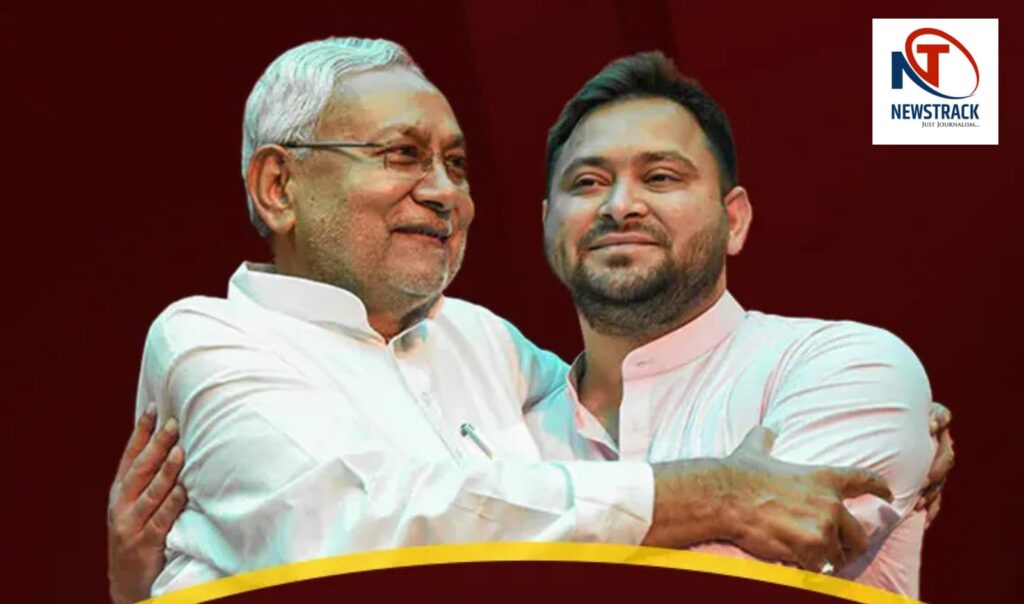
Bihar Election 2025: This is the fourth time in the last 4 decades in Bihar that there is a strong possibility of the voting percentage in the state going above 60 percent. The first phase of voting has been completed in Bihar. If seen, this time’s voting was very different from many previous elections. A record was set for the highest turnout in the electoral history of the state. Although only one phase of voting has taken place, the voters’ participation was much greater than expected. Even the Election Commission is overjoyed with the enthusiasm of the voters. He is likely to see similar huge voter turnout in the second phase also. In the first phase, almost 65 percent voting on 121 seats in 18 districts has increased the temperature of political activity. All the parties are calling it a boon for themselves. But history shows that more than 60 percent voting has been favorable for Rashtriya Janata Dal.
The ‘bumper voting’ in the state came at a time when a special intensive review (SIR) was conducted last month, against which opposition parties continued to express strong opposition. The opposition has also been accusing the Election Commission of rigging and irregularities in the voter list regarding SIR.
Voting still remains on so many seats
After voting on about 121 seats in the first phase, voting is yet to be held on the remaining 122 seats in the second phase. For this, political parties have intensified their election campaigns with greater vigor. In the first phase, apart from the Chief Ministerial candidate of the Grand Alliance, Tejashwi Yadav, the fate of many ministers including the two Deputy Chief Ministers Samrat Chaudhary and Vijay Kumar Sinha was trapped in the EVM. About 1,314 candidates contested the elections in the first phase.
This is the fourth time in the last 40 years in Bihar that there is a strong possibility of the voting percentage in the state going above 60 percent. In these 4 decades, the people of the state have not been very enthusiastic about voting due to various reasons. This is the main reason that during this period, voting of more than 60 was recorded only 3 times, and now this record is on the way to be made in the elections of 2025. The last time this happened in the year 2000 was that more than 60 percent voting took place.
60% voting means… RJD’s return decided
But… if we carefully look at the voting pattern of the last 4 decades in Bihar, then more than 60 percent voting means the return of Rashtriya Janata Dal (RJD) to power. Lalu Prasad Yadav separated from Janata Dal and formed RJD in 1997. First Lalu ran the government in the state on behalf of Janata Dal and then he returned to power on the strength of RJD. After this, due to being convicted in a corruption case, he put the responsibility of power on the shoulders of his wife Rabri Devi.
In the last 40 years, in the 1985 elections, approximately 56.27 percent voting took place for the 324-seat assembly in the state. Then Congress had registered a ‘bumper’ victory and captured power in the state for the last time on its own. In 1985, Congress won 196 seats while the second-placed Lok Dal won about 46 seats. In this election, Bharatiya Janata Party (BJP), which contested on 234 seats, stood third by winning 16 seats.
60 percent votes for the first time in 1990
Let us tell you, in the year 1990 the state had crossed the 60 percent voting mark. About 62.04 percent votes were cast in this election. This was the same period when the wave of Mandal Commission was in full swing in the country. After that, Congress suffered a crushing defeat in the 1989 Lok Sabha elections and the Janata Dal, which led the backward class, came before the public as the largest party. When Vishwanath Pratap Singh became the Prime Minister at the Centre, the reins of Bihar came into the hands of Lalu Prasad Yadav. Congress was reduced to only 71 seats, falling from 196. BJP reached 16 to 39 seats. Janata Dal, which won 122 seats, formed the government by securing majority with the support of the Left parties.
At that time, Lalu Yadav’s influence in the state was worth seeing, along with this he was also dominant at the Centre. His party got a big benefit from this in the 1995 elections also. Then there was about 61.79 percent voting here and Lalu also made a comeback to power. Let us tell you, in this election also Janata Dal ruled the hearts of the people. In the 324-seat assembly, Janata Dal fielded candidates on 264 seats and won on 167 seats. Congress was now at 29. Lalu again took charge as the Chief Minister of the state.
Then… Lalu Yadav badly trapped in corruption
By the next elections in Bihar, the controversy regarding corruption in Janata Dal deepened and Lalu was accused of ‘fodder scam’ and due to this there was a serious rift in the party. Hence, there was a massive split in the party. He separated from Janata Dal and formed Rashtriya Janata Dal party in 1997. Also, due to the court order, Lalu had to step down and handed over the reins of power to his wife Rabri Devi. After that, in the year 1997, Rabri Devi became the Chief Minister of Bihar.
In the February 2000 elections, about 62.57 percent votes were cast in the state. In this election, Rashtriya Janata Dal contested in place of Lalu under the leadership of Rabri. However, this time no party could get absolute majority in the elections. On the other hand, NDA under the leadership of Nitish Kumar got the opportunity to form the government, but after staying for only 7 days, he had to resign from the post. For this reason, Rashtriya Janata Dal leader Rabri Devi took oath as the Chief Minister.
Lalu-Rabri’s influence has ended
In this way, after the division of Bihar, the assembly seats in the state kept decreasing and due to this, Rabri was successful in gathering the required majority for the government. Along with dysfunctional law and order, the issue of manipulation and corruption became so big that a large number of people started migrating from Bihar.
Its major impact was seen in the February 2005 elections. When elections were held here in 3 phases, the voting percentage fell below 60 to about 46.50%. Due to the division of Bihar in the year 2000, the assembly seats here reduced to 243. However, due to low voting, Lalu’s party suffered a major setback and suffered a crushing defeat. During this period, no party or alliance could gain majority. Lok Janshakti and Congress’s talks with RJD did not work out. If the government was not formed, President’s rule had to be imposed in the state. That’s it… then from here the end of Lalu-Rabri era started.
What happened during Nitish’s era?
Now a new era has started in Bihar in the form of Nitish Kumar. In this first full term of Nitish, the government did a lot of work and the name of Chief Minister Good Governance Babu also became a big topic of discussion. But the indifference of the voters remained regarding the elections and this is the reason that after 5 years, when elections were held in the state in October-November 2010, the voting figure definitely crossed 50, but still very few votes were cast. Only about 52.73% votes were cast in the elections and… Nitish became the Chief Minister again.
After serving as Chief Minister for a decade, there were a lot of changes in Nitish Kumar’s Bihar. Before the 2015 elections, Narendra Modi’s era in central politics had also started, due to which Nitish Kumar separated from NDA. He entered the grand alliance with RJD. In this assembly election, the voting graph definitely increased… but it remained far away from the 60 mark. 56.91% votes were cast, an increase of 4.18% from the previous election. Even though RJD emerged as the largest single party in the state, it was Nitish who became the Chief Minister by getting 71 seats. Nitish completed his 5-year tenure by changing alliances.
So… is this a good sign for Tejashwi?
In the 2020 elections, Nitish Kumar again contested the elections with NDA. This time there was 57.29 voting with an increase of about 0.38% in the elections. The majority fell in the account of NDA. RJD became a single party with 75 seats. Whereas Nitish’s party suffered a major setback in the elections and became the third party with the loss of 28 seats. BJP got 74 seats. But Nitish completed this tenure with so many ups and downs.
And now…. If we look at it this way, in the last 40 years, whenever more than 60 percent votes were cast in the state, RJD (earlier Janata Dal) was successful in coming to power. Now if the trend continues this time too, then Tejashwi Yadav’s dream of becoming the Chief Minister can be fulfilled this time. And Nitish’s two decade old era will become history. However, the second round of voting and counting is yet to take place.