
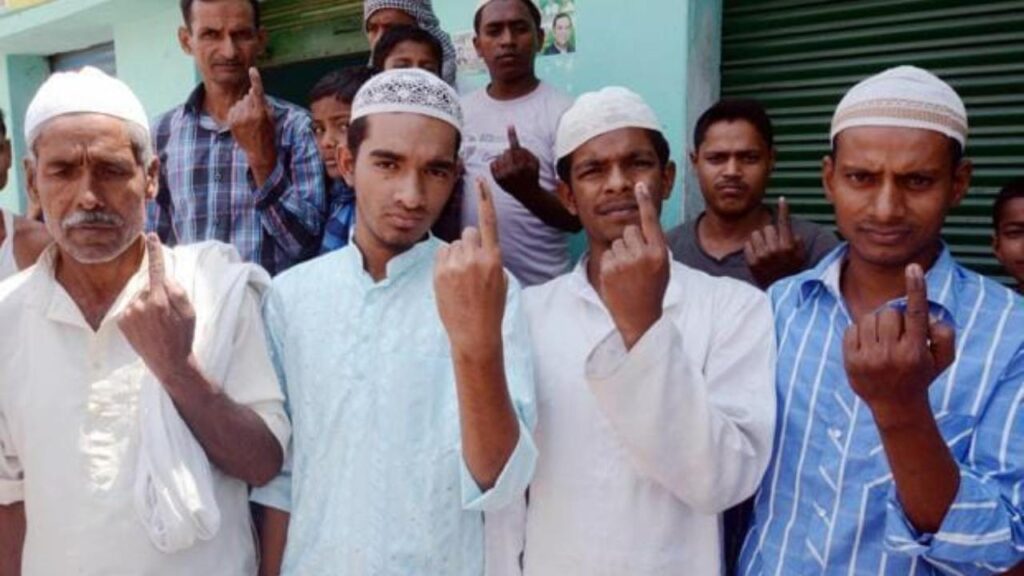
Bihar Politics 2025: A big question is stirring the politics of Bihar that where will the Muslim voters go. Whereas Tejashwi Yadav, Nitish Kumar, Owaisi and Prashant Kishore are continuously releasing arrows from their quiver. Everyone’s target is Muslim voters. In this state with approximately 17 to 18 percent Muslim population, this community is not only a large social class but also a decisive component of the electoral mathematics on many seats. According to statistics, about 37 seats in Bihar are Muslim dominated, where the role of this class plays an important role in the victory or defeat of the candidates.
Bihar politics has taken many turns in the last two decades — Lalu Yadav’s social justice politics, Nitish Kumar’s good governance model, and now Narendra Modi’s slogan of development. But the inclination of Muslim voters has mostly been in favor of Rashtriya Janata Dal (RJD).
From the 1990s to 2015, Muslims saw Lalu Yadav as a “protectorate”. However, what the Muslims got is a different question. It is believed that RJD’s “MY” (Muslim-Yadav) social structure strengthened this equation. However, in the 2020 assembly elections, there was a slight dispersion in the votes of this class. On some seats, AIMIM (Owaisi’s party) made a dent in the traditional vote bank of RJD, especially on the seats of Seemanchal area. These days, districts like Katihar, Kishanganj, Purnia and Araria have become centers of Muslim politics. In 2020, Owaisi’s party won 5 seats in these areas, although most of the MLAs later joined RJD. Still, it was a sign that Muslim voters were no longer completely lopsided.
This time two names are in discussion Prashant Kishore (PK) and Asaduddin Owaisi (AIMIM). PK has increased village-to-village contacts through his ‘Jansuraj Abhiyan’ and is active among the youth. But has his message reached Muslim voters effectively? The trends so far show that Muslims in the urban areas of Seemanchal and Patna are seeing PK as an “alternative”, but the question is also whether their trust is still more on the traditional parties RJD and Congress. Owaisi’s challenge is limited to Seemanchal, but the impact of his politics is visible on the statewide discussion. He repeatedly raises the issue that “Why is 18 percent of the population not given the share of power?” Whereas “2 percent seafarers” can get the post of Deputy CM. His emotional appeal leaves an impact in some sections, but Owaisi has not yet become a decisive force in practical politics.
If we look at the trends of the last five assembly elections, Muslim voters have often been decisive, but their decisiveness has been seen more in the politics of protest than in the strength of any one party. They go with the party which they consider to be a strong alternative in opposition to BJP or Hindutva politics. That means Muslim politics is formed differently in every seat. It has not been his politics to go with any one party and get a share in power unilaterally. In such a situation, Owaisi’s point may seem right that the direct participation of 18 percent population in power is very less. Muslims have often been important in the politics of Bihar as a “vote bank”, but their representation in the power structure has been limited. This is a point which can become a big issue in the coming election discussions.
If we look at the current political equations, the RJD and Congress alliance still has the biggest confidence in Muslim votes. But even these parties have not yet given a big post like Deputy CM to Muslims. The JD(U)-BJP alliance is weak in this category, while the AIMIM has limited influence in Seemanchal. PK’s “Jansuraj” is just a neutral hope so far, but if he turns the talk of Muslim candidates on 40 seats into reality, then considering the grassroots organization, his appeal in the coming elections may have an impact in some areas.
Muslim voters of Bihar vote more based on political wisdom than emotions. They know whom their vote defeats and whom they win. This time, Owaisi’s voice and Prashant Kishor’s strategy may definitely bring an interesting turn in some seats, but the bigger equation will remain the same. Muslim voters are still decisive, but the decisiveness is not about any one face, but about their security and participation.