
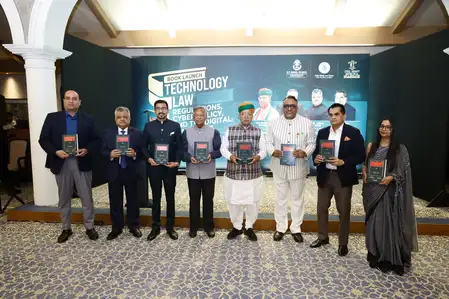
New Delhi, April 30 (IANS). “Innovation, technology or artificial intelligence cannot replace a human being. AI poses many challenges, and we are highly advanced technologically, but it cannot replace a human being,” Union Minister of State for Law and Justice (Independent Charge) Arjun Ram Meghwal said at the launch of the book Technology Law: Regulations, Cyber Policy and the Digital Landscape. This book is written by Rodney D. Ryder and Nikhil Naren.
He said, “Ever since the time of the steam engine, people have been skeptical about new developments. It brought change and increased business. As technology advances, we adapt ourselves to the changes in the world. Similarly, we are now in the age of AI and robotics, but it will also bring new opportunities. What will change will be the nature of jobs and opportunities, and experts will have to develop them. Technological interference is also increasing in the legal sector. We are now in the era of Industry 4.0. We need to embrace these new challenges and understand how they can serve the nation. The book Technology Law: Regulation, Cyber Policy and the Digital Landscape will help us understand how to make the best use of emerging technological opportunities.”
This book Technology Law: Regulation, Cyber Policy and the Digital Landscape guides readers to confidently understand and navigate their rights, risks and the intersection of law and technology.
Packed with policy and legal perspectives commonly found scattered across many specialist texts, the book is available at a student-friendly price, making it one of the most comprehensive and affordable books on technical law. It covers the entire gamut of tech law from the Indian Information Technology Act (and rules), data protection, surveillance, online brand management to new technologies.
This book will be a welcome addition to professionals’ libraries and will form an essential part of university curricula.
In his welcome speech, O.P. Founder Vice Chancellor of Jindal Global University, Prof. (Dr.) C. Raj Kumar said, “I congratulate Professor Nikhil Naren and co-author Rodney Ryder for making significant contributions to the field of technolaw. At a time when the role of AI and its future impact are being widely discussed, this type of academic work will give us clarity, consistency and better understanding of how AI will impact the future of law and justice. The knowledge society linked to innovation and technology, and the role of law and justice in our democratic Only that which strengthens institutions will take us to the goal of a developed India.”
The special guest in the program was Attorney General of India R. Venkataramani, Solicitor General of India Tushar Mehta and former G20 Sherpa of the Government of India Amitabh Kant.
Attorney General of India R. Venkataramani said, “Many books have been written on what the future will be like in a technology and science-dominated world. Sometimes it sounds scary, sometimes absolutely wonderful. But we do not know how we will get through it. Our minds cannot be subjected to any regulation other than freedom of expression. It is important for us that our minds remain dominant; and that our minds always remain as independent as possible so that they can define the fundamental concepts of the law, its limits, its application and effect. I believe the question is to deal with the impact of influences, no part of life is free from law and regulation.”
Solicitor General of India Tushar Mehta said, “India is progressing at a fast pace and we are ahead of the times in Digital India. When I talk about digital law, I mean the confluence between India and the international legal order. The world is one entity in the context of the digital medium. There are no national boundaries. There are no physical boundaries. The difficulty is that when I do something, I do it within the limits set by my Constitution, which defines my freedoms and theirs.” Similar freedoms or limitations are not found in other countries. In my view, there is no comprehensive legislative framework that regulates or defines AI. Therefore, we need professionals who understand both the technical and legal aspects of AI. If we develop technology as digital public infrastructure, keep it interoperable, open and secure, we can bring about change at the population level.”
Amitabh Kant, former G20 Sherpa of the Government of India, said, “This book is remarkable in many ways, because I have always believed that India’s digital transformation is one of the most important growth stories in the world today. We have 1.5 billion digital identities, but between 2015 and 2017 we opened 55 crore bank accounts; one bank account is opened every second in India. Then we linked them to Aadhaar and mobile numbers. This enabled faster payments and then many startups Credit, stock market, tax services in cities and insurance services should be provided in rural areas. Courts should not be considered as the first resort for adjudication. It should be a complete operating system extending to alternative dispute resolution.”
Rodney D. Ryder, co-author of the book and founder and senior partner of Screenboard, said, “This is a landmark document of the achievements we have made as a nation through technology legislation. The development of the Information Technology Act is a brilliant example of a 25-year policy process, driven forward with speed and clarity by successive governments. This book sums it up and is a resource for academia.”
Assistant Professor at Jindal Global Law School, Assistant Director of Cyril Shroff Center for AI, Law and Regulation and co-author of the book, Prof. Nikhil Naren said, “We cannot remain apolitical at any time. Policy and politics have always reached us, just as technology has reached us. So when it comes to writing something on technology and policy, it is an extremely challenging task because of its dynamic nature. I strongly believe that law should be imaginative enough to enable innovation, but also rigorous enough to protect rights, dignity and democratic institutions.”
Pro. Naren also mentioned some new ideas he would like to see included in the text, such as the concept of “social media paranoia,” a condition in which visibility, recognition, trolling, virality, and constant comparison dictate how a person thinks, behaves, and seeks acceptance.
The book also argues that the terminology of the digital age must also evolve: the term “influencer” exaggerates social influence and hides the attention economy behind it, while “clickstar” is a more accurate term for Internet celebrities whose identity is based on clicks, reach, engagement, and algorithmic visibility, rather than actual influence.
Pro. (Dr.) Deepika Jain, Executive Dean, Jindal Global Law School Introduced Jindal Global Law School. Pro. (Dr.) S.G. Sreejit, Dean, Strategy and Institution Building, Office of the Vice Chancellor, O.P. Jindal Global University presented critical appreciation and vote of thanks was given by Prof. Delivered by Pavani Jain, Assistant Director, Cyril Shroff Center for AI, Law and Regulation.
–IANS
dsc