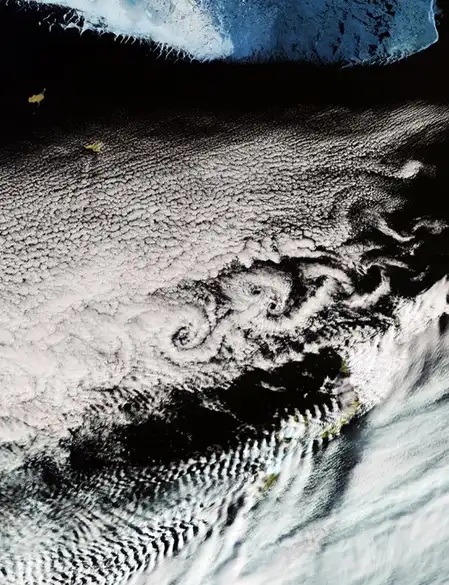
New Delhi, May 14 (IANS). Have you ever seen white clouds dancing like waves in the sky? Astronauts present on the International Space Station (ISS) have often taken such photographs. Similar spectacular views of wavy clouds were seen over the Crozet Islands in the French Southern and Antarctic regions. These clouds are called ‘wave clouds’, which look very beautiful.
Wave clouds not only present a beautiful sight but are also important from meteorological point of view. Wave clouds are also called undulatus or billow clouds. These clouds usually form over mountainous areas or islands. A photo shared by the American space agency NASA was taken on the Crozet Islands located in the South Indian Ocean. These islands are located between South Africa and Antarctica.
Now the question is how are wave clouds formed? Scientists say that wave clouds are formed due to atmospheric gravity waves. When strong wind hits a mountain or island, it rises upward. During this time the air cools down and the moisture present in it condenses and takes the form of clouds. Then due to gravity this air falls downwards on the other side of the mountain. As it descends, the air gets heated, causing the clouds to disappear. But this movement of wind does not stop. The air rises again, cools and forms a new cloud. This cycle repeats again and again, creating a wave-like pattern. Just like waves arise when a stone is thrown into water.
At the same time, in rugged areas like the Crozet Islands, cross-currents are formed in the air flow, due to which this wavy form of clouds is visible even more. Wave clouds have been seen many times before over these islands. These islands are completely uninhabited. There is no permanent population here, but these are important research centers for scientists. Here mainly king penguins and other marine creatures are studied.
–IANS
mt/pm