
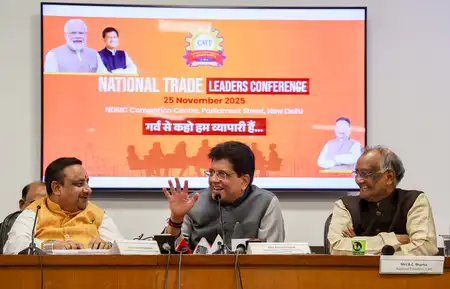
New Delhi, April 26 (IANS). Confederation of All India Traders (CAIT) on Sunday said if India’s fast-growing digital market is left unregulated, it could damage India’s traditional retail market structure, which largely generates self-employment and job opportunities in the country.
Along with this, CAIT urged the government to make a strong national e-commerce policy to safeguard the interests of small traders.
In a letter sent to Union Commerce and Industry Minister Piyush Goyal, CAT Secretary General and MP Praveen Khandelwal cited the latest joint report by Deloitte and Google titled “The $250 Billion Commerce Frontier”, saying the report clearly reflects the massive expansion of India’s digital commerce market in the future, but also emphasizes the urgent need for policy safeguards to ensure fair competition and balanced growth.
According to the report, India’s e-commerce market is expected to grow to approximately $90 billion between 2019 and 2025 and reach $250 billion by 2030.
It further said that by 2030, 22 crore new Generation Z customers will engage in online shopping, Generation Z customers will account for 45 percent of total online spending, 15 crore new customers will come online and per capita e-commerce spending is expected to double.
Tier-II cities and small towns already account for more than 60 per cent of customer purchases, accounting for almost half of total spend and 60 per cent of total orders.
Khandelwal said that these figures show the immense potential and possibilities of India’s digital market.
CAIT urged the government to immediately implement a comprehensive national e-commerce policy with provisions for strict enforcement of foreign direct investment (FDI) norms, ban on unfair pricing, regulation of illegal shops, transparency in algorithms and seller rankings, protection from illicit trade, accountability for counterfeit and substandard goods, level playing field for small and medium enterprises and small retailers, data security and a dedicated grievance redressal system for merchants and consumers.
India’s small retailers, kirana stores, wholesalers, distributors, transporters and allied sectors support crores of families in urban and rural India. He said that the weakening of this ecosystem would have serious economic and social consequences.
CAIT National President, BC Bhartia alleged that leading e-commerce companies are continuously violating the spirit of India’s FDI policy through indirect inventory ownership, preferred vendor arrangements, private labels and manipulative business structures.
What was allowed as a market model has increasingly turned into an inventory-controlled model.
He further said that practices like unfair pricing, heavy discounting through cash burn, illegal stockpiling, dark patterns, preferential listing and supply of substandard goods have become common. These methods are not only anti-competitive, but are slowly eliminating the millions of honest traders who have built India’s domestic market through trust and service.
–IANS
abs/