
New Delhi, October 14 (IANS). The levels of greenhouse gases like carbon dioxide and methane are continuously increasing in big metros like Delhi and Mumbai. This has been revealed in a study conducted by the Indian Institute of Technology (IIT) Bombay.
This study has come at a time when the air quality in Delhi has already reached the poor category and the situation is expected to worsen as Diwali approaches.
On Wednesday, Delhi’s Air Quality Index (AQI) was recorded at 201, which falls in the ‘poor’ category. On Tuesday this figure was 211 and it is estimated that by Friday it may increase to 346, which is considered in the ‘very bad’ category. This decline in air quality can pose a threat to people’s health, especially children, the elderly and those suffering from respiratory diseases.
The situation is no different in Mumbai also. Mumbai has seen a decline in air quality after the withdrawal of monsoon. The city’s average AQI last week was 153, which falls in the ‘moderate’ category, but is still considered polluted. This figure is based on data from 25 out of 30 continuous monitoring centers in the city.
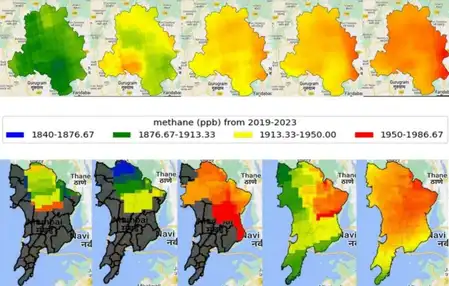
Professor Manoranjan Sahu and researcher Adarsh Algade of IIT Bombay led the study. With the help of satellite data, they analyzed the levels of carbon dioxide and methane gas in big cities like Delhi and Mumbai.
For this, carbon dioxide data was taken from NASA’s Orbiting Carbon Observatory-2 satellite and methane data was taken from the European Space Agency’s Sentinel-5P satellite.
This study revealed that the amount of greenhouse gases in these two cities is not only increasing, but it also varies seasonally and regionally. This means that the level of gases may be higher in a particular season or place. For example, methane ‘hotspots,’ or areas of high concentrations, were typically found where there were garbage dumps, sewage, and high industrial activity.
The researchers also developed city-specific statistical models to predict future levels of gases. They used a mathematical model called Seasonal Autoregressive Integrated Moving Average (SARIMA), which analyzes data changing over time.
“Data obtained from satellite can be very beneficial for policy makers,” the researchers said in a paper published in the journal Environmental Science and Pollution Research. With this, it can be found out which area is causing more pollution and how improvements can be brought there. The increasing amount of both carbon dioxide and methane gases gives serious indications towards climate change and it is necessary to pay immediate attention.
Meanwhile, in view of the increasing pollution in Delhi, the Commission for Air Quality Management (CAQM) under the Central Government has implemented some strict rules under the first phase of the Graded Response Action Plan (GRUP).
–IANS
PK/AS