
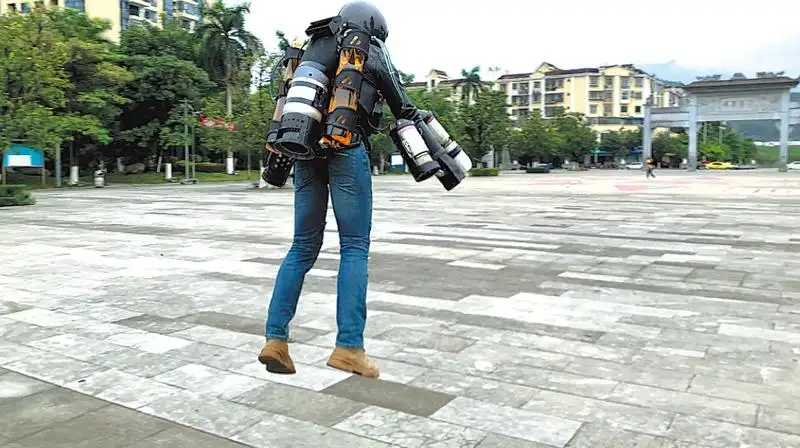
China has surprised everyone with another big invention for humanity. Chinese scientists have created a “flying backpack” that will allow anyone to fly at a speed of 100 to 150 kilometers per hour. This is being called the future of human flight. It will change human life on Earth. With this, people will neither have to waste time in heavy traffic nor face such obstacles in their journey.
Chinese scientists created amazing “flying backpack”
Chinese scientists have recently developed a flying backpack that can fly at a speed of 100 kilometers per hour and reach a height of 1,500 meters. This news has shocked the whole world. As soon as this video went viral on social media, people’s interest in flying has increased. Everyone wants to know about this backpack and order it so that they can fulfill their dream of flying.
How does a backpack work?
This device is a “flying board”. The user stands on it and controls it using his body balance.
There are five small turbo-jet engines located in the lower-middle part of the board.
A fuel pack, similar to the user’s backpack, provides fuel to the engine.
The user controls the flight using body balance and control devices.
Other features of the backpack
A person can fly with a weight of about 80 kg. The flight range is said to be around 100 km. The maximum speed can be between 100 to 150 km/h. Currently, this backpack is designed for R&D and specific applications (such as disaster relief, high-altitude expeditions).
Possibilities and Challenges
It can be helpful in disaster relief, access to hilly areas and fire fighting at high altitude.
This could be a revolutionary step towards personal “air mobility” in the future.
There is a problem with the battery or fuel supply. This means that the engines are jet-turbo. Fuel consumption will be higher.
The rules for flight control, stability, safety standards, licensing and air-to-air flight areas have not yet been fully developed.
Factors such as user safety, altitude, speed, and atmospheric conditions can increase the risk.