
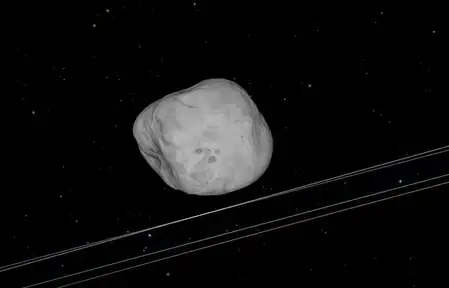
New Delhi, 4 October (IANS). According to the US space agency NASA, the rare comet 3I/atlas, passing at a speed of 61 kilometers per second from the solar system, does not have any threat to the Earth.
Comet 3I/Atlas is the third known body discovered outside our solar system, before ‘Oumuamua’ (in 2017) and 2I/Borisov (in 2019) were discovered.
The letter ‘Eye’ means ‘Interstaller’ (interlear), which shows that this body has come from outside our solar system. This is the third known internet body, so it is named ‘3’ in its name.
It was first discovered by survey telescope, a survey telescope, a survey-funded Atlas (asteroid terrestrial-affecting system) funded by NASA at Rio Hartado, Chile. It observed the small planet center of comet 3I/Atlas on 1 July 2025.
According to NASA, this rare comet is traveling at a very fast pace, yet there is no danger to us.
The US Space Agency said, “When it was discovered, the internal comet was traveling at a speed of about 137,000 mph (221,000 km per hour or 61 km per second), and as it would come near the Sun, its speed will increase as it would come near the Sun.”
The 3I/Atlas is expected to arrive at the closest point of the Sun around 30 October, which will be about 21 million kilometers just inside the orbit of Mars.
NASA said, “Comet 3I/Atlas is no threat to Earth and it will remain far away from Earth. It will be around 1.8 astronomical units (about 17 million miles or 27 million kilometers) near our planet.”
The space agency, which is monitoring the comet through its various space telescopes including the Hubble, Web and Safarex, has confirmed that there is no danger of this internal body colliding with the earth.
It further states, “Although the projection path of this body brings it to the inner solar system, it will not come close to the Earth. As the comet 3I/Atlas passes through the solar system, it will not come closer than 1.8 astronomical units (about 17 million miles or 27 million kilometers) from our planet.”
The comet will pass behind the sun in late October and pass near Jupiter in March 2026 and exit our solar system.
-IANS
KR/