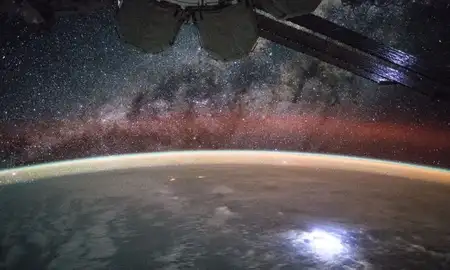
New Delhi, March 1 (IANS). As soon as we imagine the Earth from space, beautiful pictures of the ‘blue planet’ often emerge in our minds. However, an amazing sight is seen when viewed from the International Space Station (ISS) located in low Earth orbit. At an altitude of just 300 miles above the Earth, bright layers of red, green, violet and yellow lights are visible in the upper atmosphere. In scientific terminology it is called ‘airglow’. It is Earth’s natural glow that keeps the sky from becoming completely dark at night and reflects the complex processes of our atmosphere.
According to the US space agency NASA, airglow occurs when atoms and molecules present in the upper atmosphere become more active than sunlight. They emit light in the form of photons to release their excess energy. The process is similar to the aurora, but the aurora is created by high-energy particles from the solar wind, whereas the airglow draws energy from normal everyday sunlight. Sometimes ionized atoms collide with free electrons and produce light.
The night sky is never completely black. Even after removing light pollution, moonlight and stars, a light colored glow is visible and this is airglow. This is about one tenth of the total light of all stars. When seen from space, it looks like a shiny bubble surrounding the Earth. It extends at an altitude of 50 to 400 miles, where the ionosphere is located. Our GPS signals pass through this area and astronauts travel from here.
The colors of airglow come from different gases. Green light is the brightest, which is made from oxygen atoms. Red and other colors result from various reactions of nitrogen and oxygen. Some colors are in UV and infrared, which are not visible to the eye. Due to the thin upper atmosphere, atoms remain excited for a longer time without colliding and are able to emit light. There are more collisions in the dense atmosphere at the bottom, so less light is produced. This brightness changes constantly as it is affected by both the sun’s energy and Earth’s weather.
Airglow serves as a marker of changes in the ionosphere, just as smoke in the air shows how the wind is blowing, so airglow indicates the movement and presence of particles. This provides information on temperature, density and composition, which helps in understanding the relationship between space weather and Earth’s climate.
Scientists are continuously studying this beautiful phenomenon because it is an important means of understanding the connection between space and Earth’s weather. These colored stripes are clearly visible in photographs taken from the ISS, which help scientists monitor the activities of the upper atmosphere.
–IANS
MT/AS