
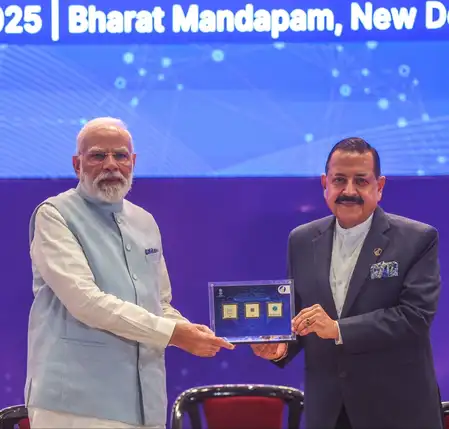
New Delhi, November 4 (IANS). Prime Minister Narendra Modi dedicated three revolutionary indigenous innovations to the country at the ‘Emerging Strategic Technologies and Innovation Conference (ESTIC) 2025’ organized in collaboration with the Department of Science and Technology (DST). Union Minister of State (Independent Charge) for Science and Technology Jitendra Singh praised it and described it as ‘India’s biggest tech leap’.
The three innovations include QSIP (Quantum Secure Integrated Processor), 25-qubit QPU (Quantum Processing Unit) and CAR-T cell therapy.
Union Minister of State for Science and Technology (Independent Charge) Jitendra Singh wrote on social media platform Computing Chip and CAR-T Cell Therapy: India’s first indigenous cancer cell therapy. These major breakthroughs establish India as a global science and technology powerhouse.”
QSIP is India’s first indigenous quantum security chip, jointly developed by DRDO and IIT Madras scientists. This chip is based on quantum key distribution technology, which ensures completely secure communication from hacking. It will be used in defence, banking and government data centres.
The 25-qubit quantum processing unit (QPU) is India’s first fully indigenous quantum computing chip. It was developed by scientists from IIST Bengaluru and TIFR Mumbai. This chip is based on superconducting qubit technology and can perform calculations millions of times faster than existing supercomputers. Will revolutionize drug discovery, weather forecasting, financial modeling and AI training. India has now joined the few countries making quantum chips after America, China and Canada.
CAR-T (Chimeric Antigen Receptor T-cell) therapy is India’s first indigenous gene-based cancer therapy, jointly developed by IIT Bombay and Tata Memorial Hospital. This therapy will prove to be a boon for blood cancer patients like leukemia and lymphoma. The patient’s T-cells are extracted and genetically modified, which recognize and destroy cancer cells. In foreign countries this treatment costs Rs 4-5 crore, whereas in India it will be made available for only Rs 40-50 lakh. Soon it will be launched in the market after completing clinical trials.
–IANS
SCH/AS