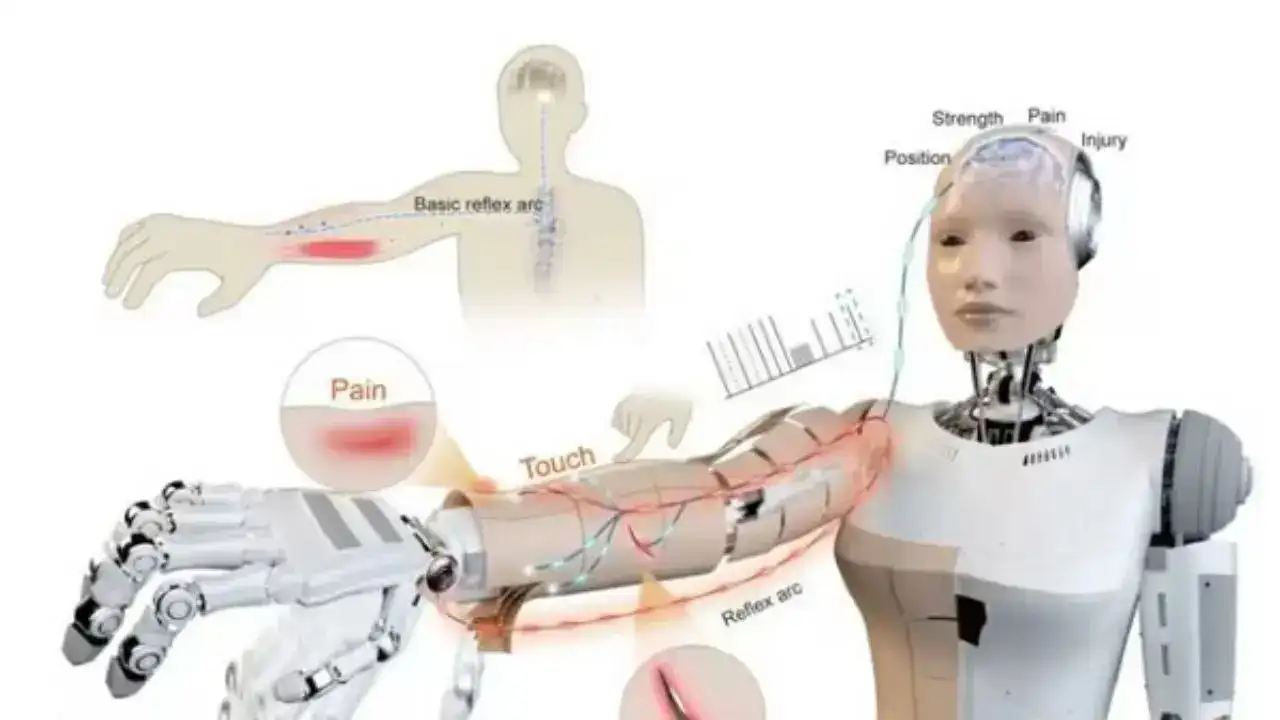
Taking a big step in the world of robotics, Hong Kong scientists have developed an electronic skin that can sense touch and react like a human. The purpose of this new technology is to make humanoid robots safer, more sensitive and more responsive.
Artificial skin inspired by human nerves
A team led by engineer Yufei Gao at the City University of Hong Kong has created a unique neuromorphic robotic skin. This technology processes touch and pain like the human nervous system. According to research published in the journal PNAS, this e-skin is capable of sensing contact with a surface, sensing damaging pressure, and taking immediate protective action.
Differentiating between light touch and harmful pressure
While conventional robotic skin only measures pressure, this new e-skin converts touch into electrical signals that mimic human nerve signals. The higher the pressure, the clearer the signal. This allows the robot to differentiate between a light touch and a dangerous impact.
How does the human reflex system work?
This electronic skin is made up of four different functional layers that act like biological nerves. When light contact occurs, the signal is transmitted to the central processor, where it is used for tasks such as sensing objects or safely interacting with humans. However, as soon as the pressure exceeds a certain “pain threshold”, the system works completely differently. The signal bypasses the main processor and goes directly to the motors. As a result, the robot immediately retreats, just as a human would withdraw his or her hand from a hot or sharp object.
Increased security due to faster response
Scientists say this direct signal path significantly reduces response times. This not only protects the robot from harm, but also improves the safety of surrounding objects and people. Simply put, the skin has its own local “pain response” system.
ability to monitor oneself
Another unique feature of this system is its ability to monitor its condition. Each sensor placed in the skin continuously sends a small signal, which indicates that it is working properly. If there is a cut or tear, the signal goes off, and the robot immediately identifies the damaged part.
Easy repair, no need to disassemble the entire structure
Although this skin cannot repair itself, it is incredibly easy to repair. Made of magnetic modules, this e-skin is put together like building blocks. If a part fails, it can be removed and replaced in a matter of seconds, without having to dismantle the entire robot.