
New Delhi, May 24 (IANS). The world of space is full of mysteries as well as adventures. Even a small activity done on Earth in space can be a big deal or a challenge. One such problem is eyewash in space, as easy as it is on Earth, it is more difficult in space. However, astronauts use ‘Seal Eye Irrigation Goggles’ to get relief from this problem.
An old video of Group Captain Shubhanshu Shakla, an Indian Air Force pilot and India’s selected astronaut, has surfaced, in which he was seen sharing important information regarding minor medical problems in space. Shubhanshu Shakla has been associated with India’s Gaganyaan Mission.
In the video, he was seen saying, any small problem in space can turn serious very quickly because the nearest hospital is 400 kilometers below the earth. In such a situation, astronauts take basic medical training before flight. Shubhanshu told that the microgravity of space (zero gravity) makes even the easiest work extremely difficult. The biggest example of this is eye washing.
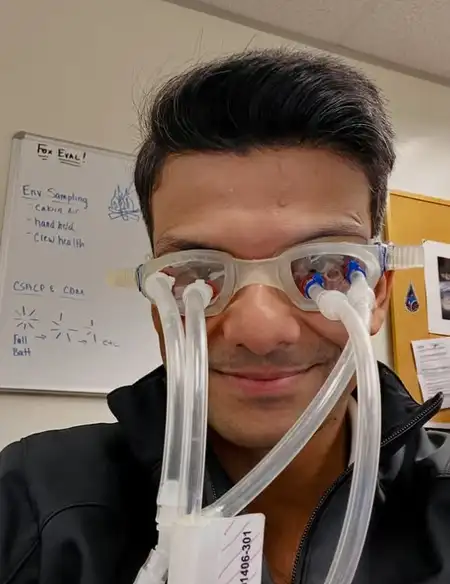
On earth, if something gets into the eyes, we easily wash it with water. But water neither flows in space nor stops at one place. It starts floating in small spherical droplets and starts moving here and there throughout the spacecraft. If an astronaut gets injured or gets dust in his eyes, it becomes impossible to wash his eyes normally. To solve this problem, scientists use ‘Seal Eye Irrigation Goggles’.
These are special types of sealed goggles, which look like science fiction movies. The specialty of the goggles is that these goggles fit perfectly on the eyes and have two tubes. A tube takes in sterile saline (purified water) and washes the eye. At the same time, the second tube takes out the dirty water immediately with the help of suction. It is a completely ‘closed system’, due to which water does not spread anywhere and the cabin remains clean. This system is designed like swimming goggles.
Shubhanshu Shakla said, “Fortunately, it did not have to be used during my mission, but astronauts hope that they do not need these devices. In space, moon dust or other particles pose a danger to the eyes, so this device proves to be very useful.”
–IANS
mt/pm