
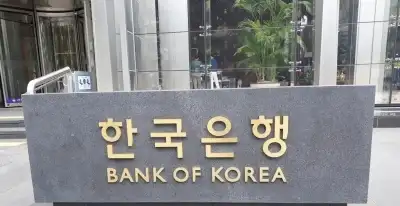
Seoul, October 23 (IANS). South Korea’s central bank on Thursday decided to keep its policy interest rate (benchmark interest rate) unchanged at 2.5 percent. This step has been taken with the aim of maintaining financial stability amid the booming housing market, rising household debt and weakening local currency.
The Monetary Policy Board of the Central Bank of South Korea took this decision in a meeting held in Seoul. This is the third consecutive time that the bank has not made any change in interest rates. However, the bank also made it clear that continued monetary easing is necessary to support the economic recovery.
“Given the impact of stabilization measures on the real estate market, the housing market situation in Seoul and surrounding areas, household debt and exchange rate volatility, it is necessary to continue monitoring the financial stability situation,” the Bank of Korea said in a statement.
Five out of six members of the board voted in favor of keeping the interest rate stable. Four members suggested keeping open the possibility of further interest rate cuts in the coming three months. This information was given by Bank of Korea Governor Ri Chang-yong in a press conference.
The central bank started monetary easing in October 2024 and a total of 100 basis points (1 percent) have been cut so far. The most recent cut was made in May, but rising house prices and household debt have left the bank with limited scope for further cuts.
Governor Ri Chang-yong said, “Real estate prices in Seoul and its surrounding areas are too high compared to income levels, which is a concern for both social stability and economic growth. I believe current property values are undermining economic growth.”
He said, “Economic growth is still low and the current environment is not conducive to keeping interest rates stable, but a reduction in lending rates could further heat up the real estate market. So by keeping rates stable, we are indicating that the coming cuts will be gradual and limited in scope.”
Economic experts predict the bank may go on a longer pause after another modest rate cut in November.
Meanwhile, the government has taken several steps to cool down the real estate market. Recently, the government has declared 21 additional districts of Seoul as ‘Speculative Zones’. Now all 25 districts of the capital Seoul have come under the ambit of strict rules.
Besides, the home loan limit has also been reduced. Now it has been increased to 200 million won (about 1.39 lakh US dollars), whereas in June this limit was 600 million won.
Household loans granted by banks have been rising steadily, reaching a record high of 1,170.2 trillion won by the end of last month. However, due to strict rules its growth rate has slowed down somewhat.
The country’s household debt-to-GDP ratio has also increased to 89.7 percent, marking the first increase in the last 15 quarters.
The decline of the South Korean won also remains a matter of concern for policymakers. The local currency has slipped below 1,420 won per dollar. This is the lowest level in several months.
The local currency opened at 1,431.8 won per dollar on Thursday, 2 won weaker than the previous session.
Ri Chang-yong said, “If the tariff negotiations are successfully completed, the pressure on the currency may ease somewhat, but we still need to look at the details related to the $350 billion investment fund. Our goal is not to level the exchange rate, but to control its volatility.”
In July, a framework agreement was reached between Seoul and Washington, under which the US agreed to reduce the tariff rate on South Korean goods from 25 percent to 15 percent, while Seoul promised to create a $350 billion investment fund.
–IANS
VKU/VC