
Until recently, app developers used to charge lakhs of rupees to create even a small, basic app. This was because building an app required a command of a programming language, and of course, not everyone could learn coding. People were forced to pay developers as per their demand, and there was no scope for negotiation. But now the situation has completely changed, and in the next few years the arbitrariness of app developers will end. Just imagine, you have an idea to create a great app, but you don’t even know the basics of coding. By now, your idea would have remained just a dream, or you would have had to spend lakhs of rupees hiring developers.
Developers have always been fooling non-technical people because of their lack of coding knowledge. But now, thanks to AI, the situation has changed. There is a new revolution called “no-code” in the world of technology. The story of Google started in a garage, and no one could compete with it.
Earlier we told you how you can create an app without any programming language. We also told you about many tools for this. But now Google has launched its no-code app maker Opal in India. Although Google Opal has its limitations, you cannot build scalable apps with it. However, using some tools, you can create scalable apps without knowing any programming language.
No-code app making
Yes, now you can build your apps without writing a single line of code. Terms like ‘no code’ and ‘low code’ are becoming popular recently. Full credit for this goes to Generative AI, which is now writing code as fast as humans.
Google Opal was first launched as an experiment in America. The company also said that they did not expect that this experimental tool would enable people to create professional-level apps, but now it is happening.
However, Google is not the first company to offer a no-code app making tool. Many low-code tools existed before Google, but Opal is the simplest and smartest of them.
What is Google Opal?
In simple terms, Google’s Opal is a ‘no-code’ mini-app building platform. Here, users can create apps without any programming language knowledge. Using Opal is as easy as writing a message on WhatsApp. All you need to do is tell us in your normal language, like Hindi or English, what kind of app you want, and Opel’s AI will take care of the rest of the technical work. This platform is a game-changer for everyone who wants to turn their ideas into reality. Be it a student, a small shopkeeper, a home chef or a content creator.
How does Opal work?
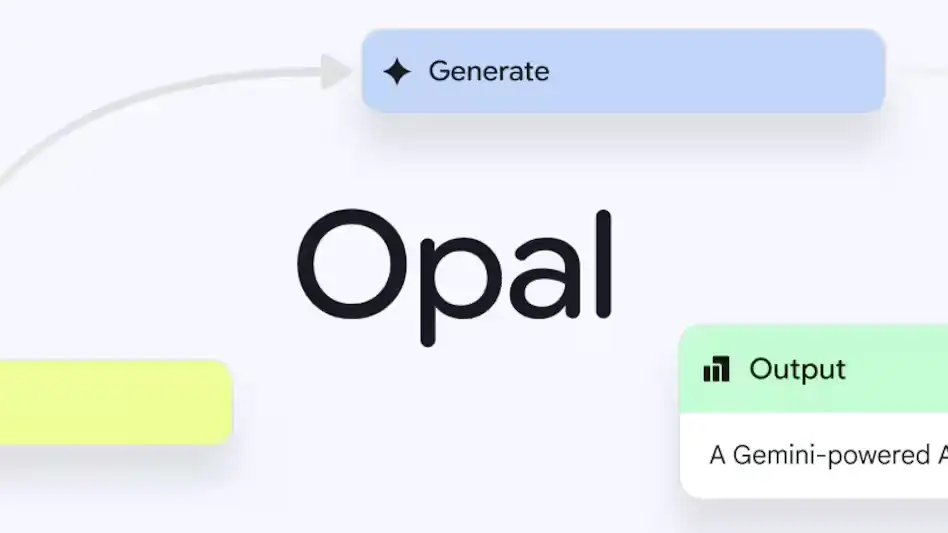
Opal is a ‘no-code’ platform that works on simple commands or prompts given by the user. It is powered by the best technologies of Google. Google’s powerful Large Language Models (LLM) and generative AI operate in the backend. Opal’s user interface is simple and attractive. You can visually see the workflow and logic of the entire app. Unlike cloud code and cursors, you won’t see any annoying code here. The company has tried to make it visually attractive, making it easy to use for any user.
The whole process works like this:
When a user describes a need—for example, “I want an app that can take online orders for my small coffee shop and store customer data,” Opal’s AI deeply understands the command.
Then, the AI automatically writes the necessary code in the background, builds the app’s UI, and sets up the database. Users simply have to finalize the look and color of the app to suit their brand using the drag-and-drop feature.
The entire process is completed in just a few minutes, whereas creating even a mini-app using traditional methods would have taken weeks, and cost developers a lot of money.
Why is this such a big change for India?
India is the fastest growing digital economy in the world. It is home to millions of small businesses (MSMEs), startups and individual creators. Most of these people want to take their businesses online, but the cost of building a basic app can range from Rs 50,000 to lakhs. Google Opal solves this big problem.
What’s possible with Opel?
A small restaurant in Noida can create a mini-app for its daily deals.
A local gym trainer can launch a workout tracker app for his clients.
A wedding planner can create a checklist app for couples.
College students can create an information app for their annual function in just a few hours.
This will boost campaigns like ‘Digital India’ and ‘Startup India’ at the grassroots level, as small traders will not have to turn to coders for basic mini-apps.
So, are coders’ jobs at risk now?
Experts believe that the advent of no-code platforms like Opal is not about the end of traditional coding, but rather about making technology more accessible. Complex, high-performance and high-security apps like banking, trading or large-scale e-commerce will always need skilled developers. But now programmers won’t be able to fool people from non-technical backgrounds and will also be less likely to overcharge them. Tools like Opal are ideal for automating small tasks, simplifying business processes, and quickly testing ideas. These will also save developers time, allowing them to focus on larger and more challenging projects.