
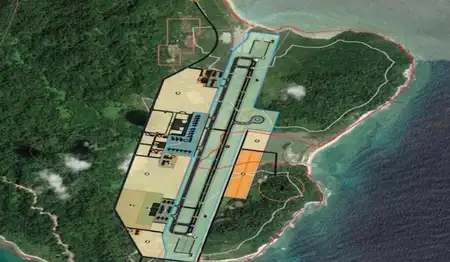
New Delhi, May 2 (IANS). According to a new report, through the Great Nicobar Project, India can convert the advantages of its geographical location into economic strength, strategic depth and maritime influence.
The island is remote, the project is expensive and there are risks in its implementation. But its basic idea—that a geographic area is lost if it is not used—is correct. Hans Kaufmann, a renowned economist specializing in global financial policy, has written this in ‘India Narrative’.
He also said that the Great Nicobar Project is not to ‘encircle’ China militarily, as this is not possible due to distance and military strength difference.
But it gives India surveillance, logistics support and a strategic position near the sea route on which China’s economy largely depends.
“If India builds it right, it will be the most important maritime infrastructure decision since independence. But if it is built carelessly, it will result in an incomplete port at the expense of a precious environment. The difference is not in ambition but in better governance,” he said.
According to the government, the project aims to transform Great Nicobar into a strategic maritime and economic hub. It is located near the global East-West shipping route and will reduce dependence on foreign transshipment ports, which is also important for India’s defense and national security.
This project will strengthen India’s strategic presence in the Andaman Sea and South-East Asia. Along with this, along with economic development, environmental protection and protection of local communities will also be taken care of.
According to the report, India is located along the Indian Ocean and has a long coastline, yet for years it has been dependent on foreign ports such as Singapore, Colombo and Port Klang to transport its own goods.
Nearly 3 million containers (TEU) of Indian goods are moved through foreign ports every year, of which just three ports handle more than 85 per cent.
Due to this, India suffers a loss of about 200-220 million dollars every year.
The report said that “India has been a tenant of its own region. The Great Nicobar Project is the first serious attempt to change this situation and its ambitions extend far beyond shipping logistics.”
In particular, if an International Container Transshipment Terminal is built here, India will get the revenue which is currently going abroad. This will also save time for exporters and increase India’s global trade competitiveness.
According to government estimates, the project could generate around $3.16 billion annually by 2040, while the total cost is between $7.90 and $8.53 billion.
Furthermore, the estimate of 50,000 jobs is a target, not a guarantee. But the economic thinking behind this project is quite strong.
“Both India’s ‘Maritime India Vision 2030’ and ‘Sagarmala Programme’ have prioritized port-led development. Great Nicobar is where this goal can turn into a real geographical advantage,” the report said.
–IANS
DBP