
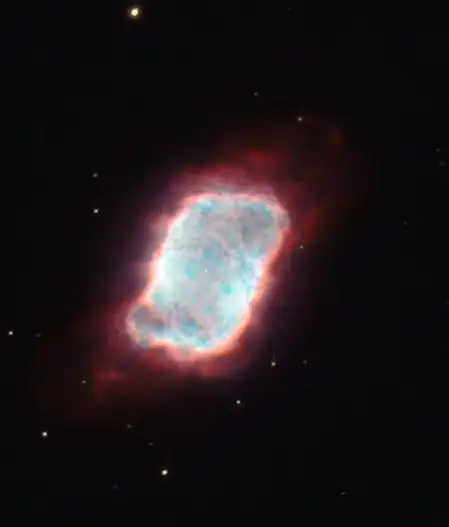
New Delhi, May 18 (IANS). The European Space Agency (ESA) has released a stunning picture of what an aging star looks like in its final stages. This image from the Hubble Space Telescope shows a planetary nebula, in which the star’s outer gaseous layers have spread into space and shine in bright ultraviolet light.
ESA shared the photo on its official Instagram account and wrote, “Hubble time! This photo is of a planetary nebula called NGC 6741, which is also known as the Phantom Streak Nebula. This nebula is located in the Aquila (Eagle) constellation, about 7 thousand light years away from Earth. Don’t be confused by the name Planetary Nebula, because it does not have any planets. In the 18th century, astronomers discovered this gas in telescopes. The spherical clouds of the Sun looked like the planets of our solar system, hence it got this name.
NGC 6741 is very bright, but it appears very small through ordinary binoculars. It was first discovered by Edward Charles Pickering in 1882.
If we look at the life cycle of an old star, when medium-sized stars like the Sun or slightly larger stars start exhausting their fuel, they turn into ‘red giants’. In this phase the star expands and releases its outer gaseous layers into space. The remaining hot and small star at the center emits strong ultraviolet rays, which make these gases glow. This state is called planetary nebula. These nebulae usually continue to shine for about 10 thousand years. The gas then slowly dissipates, leaving behind only a cool, faint white dwarf star.
NGC 6741 is different from the usual spherical nebulae. Its shape is rectangular, which looks much like a glowing pillow. Scientists believe that a second star i.e. binary star is also present in it, due to which its shape has become unique. Planetary nebulae usually appear in the form of rings, saucers or tubes. Their shape is determined by the magnetic field and the influence of other stars present nearby.
–IANS
MT/AS