
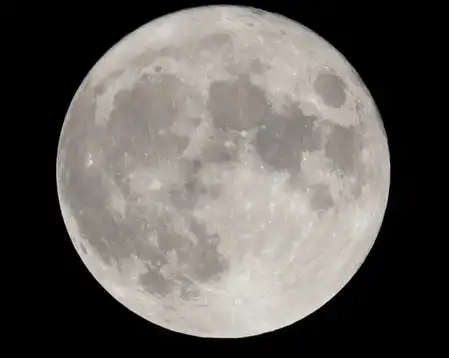
New Delhi, May 29 (IANS). The second full moon of the year i.e. Blue Moon will be visible on May 31. This beautiful moonlit night is a golden opportunity for photographers. Don’t just enjoy seeing the moon, but also capture it in your camera forever. Whether you are a beginner or an experienced photographer, if you also want to capture memorable and perfect photographs of the moon, then the Moon Photography Guide of the American space agency NASA can be useful for you.
In reality, it is not that easy to capture the moon appearing peacefully in the sky on camera. With a little knowledge, the right settings, and a little practice, you too can take great photos of the moon. The best thing is that there is no need to buy expensive equipment for this. Initially, you can take great pictures with the camera or phone you have.
First decide what kind of photo you want to take. Want to show the moon as a silhouette among the trees, or capture an orange moon near the horizon? Or want to show the changing phases of the moon throughout the month? A digital camera (DSLR or mirrorless) offers a better option than a phone. If you have a DSLR then use it. For this, take pictures in RAW mode, so that you can edit them easily later.
To take a photo of the moon, put the camera on manual mode. At the same time, pay attention to the three main settings, aperture (f-stop), shutter speed (exposure time) and ISO. Aperture determines how much light comes in, shutter speed determines how long light stays in, and ISO determines the camera’s sensitivity to light.
The simplest rule is ‘Looney 11’ in NASA’s guide. Set the aperture to F/11. Then keep the ISO and shutter speed the same. For example ISO 100 → shutter speed 1/100 sec, ISO 200 → shutter speed 1/200 sec. At the same time, for low ISO, start at 100, because the moon is very bright. Try taking a photo and changing the settings to get better results.
“Lucky imaging” is very important in moon photography. To get a good picture it is necessary to take hundreds of photographs. In some photos the moon will be in perfect focus without camera shake and the environment will be still. Later, the photographs can be improved by editing on the computer.
If you have a telescope, you can clearly capture the moon’s craters, mountains and pits. Photographs can also be taken by placing the phone or camera on the eyepiece of the telescope. It takes some practice. If we look at other useful tips, use a tripod so that the camera does not shake. Use a wide lens or a telephoto lens to frame the moon. Go out only when the weather is clear.
–IANS
MT/DKP