
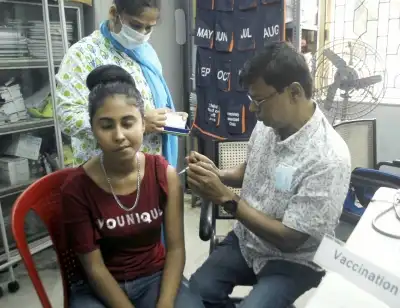
New Delhi, December 20 (IANS). According to a study, the human papillomavirus (HPV) vaccine, which is known to prevent cervical cancer, may also help protect against pre-cancerous lesions (abnormal lumps, lesions, or abnormal tissue) of the vulva and vagina in girls and women.
The HPV vaccine effectively helps prevent pre-cancerous lesions that may lead to cervical cancer in girls and women. This vaccine prevents infection with the types of HPV viruses (HPV-16 and HPV-18) that can cause cancer.
The study, published in the journal JAMA Oncology, found that women who received at least 1 dose of the quadrivalent HPV vaccine had a 37 percent lower risk of high-grade vulvovaginal lesions compared with unvaccinated women.
The reduction in high-grade vulvovaginal lesions among women who received the vaccine at ages 10 to 16 was significant, as they had a 57 percent lower rate of vaginal or vulvar precancer than unvaccinated women.
“These results emphasize the important role of starting HPV vaccination at an early age,” said researchers from the Karolinska Institute in Sweden.
The team conducted a cohort study (a group of people with a particular characteristic tracked over a long period of time) of 778,943 women born between 1985 and 1998 and living in Sweden from 2006 to 2022.
During follow-up, 98 cases of high-grade vulvovaginal lesions were found in vaccinated women, and 547 cases were found in unvaccinated women.
Vulvar and vaginal lesions are a variety of skin changes (lumps, lesions, cysts, discoloration) around the genitals that can range from mild (infections, cysts, skin conditions such as lichen sclerosus) to precancerous (VIN) or cancerous. These often cause itching, pain, burning or discharge.
Finding vulvar and vaginal lesions in the precancerous (precancerous) stage – before they turn into life-threatening cancer – is important because early detection increases the chance of cure.
HPV is the most common sexually transmitted infection worldwide and is responsible for more than 690,000 new cancer cases each year. It is the main cause of cervical cancer in both women and men, as well as many other genital and head and neck cancers.
A recent study showed that the HPV vaccine not only prevents cervical cancer, but also provides significant herd immunity, protecting even unvaccinated young women.
–IANS
kr/