
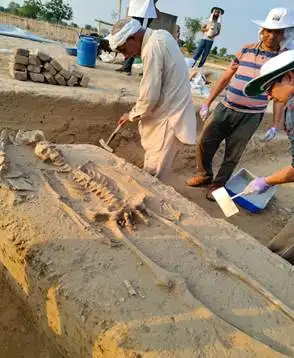
New Delhi, June 22 (IANS). The Archaeological Survey of India (ASI) has formally handed over human skeletal remains excavated from the archaeological site Rakhigarhi in Haryana to the Anthropological Survey of India (ANSI). An official confirmed this on Monday.
Director of ANSI Professor B.V. Sharma said the skeletal remains have been transferred under a recent memorandum of understanding (MoU) signed between the two institutions. This is expected to give a great boost to multi-disciplinary research on one of the most important urban centers of the Indus-Saraswati Civilization.
Researchers believe that these remains provide a rare opportunity to use modern scientific techniques. These include ancient DNA analysis, stable isotope studies, osteology, study of ancient diseases, and environmental reconstruction.
These methods are expected to yield important information about ancestry, migration patterns, diet, prevalence of diseases, adaptation strategies and human-environment interactions during the Harappan period.
Rakhigarhi, spread over approximately 550 hectares in Haryana, is considered to be the largest known site of the Indus-Saraswati civilization. Archaeological excavations have revealed evidence of continuous habitation from the Early Harappan to the Mature Harappan period, including planned settlements, drainage systems, craft production centres, trade networks and cemeteries.
In the excavation conducted during the 2025-26 field season by the Greater Noida-based Excavation Branch-II of the Archaeological Survey of India (ASI), archaeologists discovered eight tombs at Mound No. 7. This area was earlier identified as a cemetery.
Three complete human skeletons and skeletal fragments found from other graves have now been transferred to the Ancient Human Skeletal Repository and Laboratory of the ANSI in Kolkata for detailed examination, an official statement said.
The remaining skeletal material found from these sites is also expected to be transferred in a few days.
Professor Vijay Prakash, a former faculty member of Andhra University, called this transfer of skeletal material an important step. He said this would ensure that biological heritage obtained from archaeological excavations is scientifically analyzed and preserved by national institutions for the benefit of future generations.
Professor Uday Pratap Singh of Lucknow University also said that this transfer is an important milestone towards strengthening India’s paleo-anthropological (ancient human science) research tradition. He said that ANSI’s expertise in human biology and osteology puts it in a strong position to re-understand aspects of population history, health, lifestyle and cultural adaptation in the Indus-Saraswati Civilization.
Subhash Walimbe, an anthropologist and former professor at Deccan College, Pune, stressed that in-depth anthropological investigation of the remains is necessary to understand how urbanization affected the biological and pathological responses of humans.
Officials said this collaboration between ASI and ANSI is an important effort towards bringing together archaeology, anthropology, genetics and environmental sciences in the study of India’s ancient past.
The statement said that the remains recovered from Rakhigarhi are expected to be of great help in understanding the origin, health, movement and biological history of one of the world’s earliest urban civilizations.
–IANS
SCH/VC