
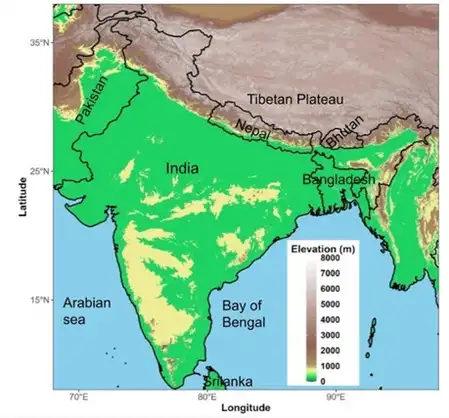
New Delhi, May 15 (IANS). Researchers at the Indian Institute of Technology, Roorkee on Friday developed and released an open-access high-resolution climate projection dataset for India. This data set, named ‘INDRA-CMIP6’, will help strengthen regional climate adaptation, disaster preparedness and climate risk assessment in India.
This data set, developed by researchers from the Department of Hydrology, IIT Roorkee, has been published in the Nature Portfolio’s journal ‘Scientific Data’. This dataset provides estimates of daily rainfall and temperature at a spatial resolution of approximately 10 km for the Indian subcontinent.
This initiative has been started with the aim of addressing a major problem related to global climate models. Global models often provide large-scale projections that fail to adequately capture India’s complex topography, monsoon system and regional weather extremes.
The impacts of climate change have increased rapidly in India in recent years, including rising temperatures, erratic monsoons, urban flooding, heat waves and increasing pressure on water resources.
The researchers said climate projections at the district and river basin level are necessary for measures such as urban drainage planning, strengthening embankments, flood preparedness and climate-resilient agriculture; Continental average figures alone are not sufficient.
The INDRA-CMIP6 dataset is built on the output of 14 CMIP6 global climate models. For this, a statistical downscaling technique called ‘Double Bias-Corrected Constructed Analog (DBCCA)’ was used.
According to the researchers, this technique better reflects daily weather variations, regional rainfall distribution and temperature extremes in the Indian subcontinent.
This dataset includes estimates of daily precipitation, minimum temperature, and maximum temperature at 0.1° × 0.1° resolution.
The researchers have also made multi-model ensembles available, along with the output of individual climate models, allowing users to compare different projections and also assess uncertainties rather than relying on just one climate projection.
Technical tests conducted by the research team found that Indra-CMIP6 significantly reduces many common errors found in global climate models.
This dataset also improves the assessment of extreme rainfall and temperature events. This is especially important for areas where local geography, monsoons and mountain structure influence climate risks.
Ankit Aggarwal from the Department of Hydrology, IIT Roorkee said, “Climate risks in India are largely concentrated at the local level, especially in the monsoon and hilly regions. Micro-level climate projections like INDRA-CMIP6 are extremely important in translating global climate science into useful information for planners, researchers and policy makers. Making such datasets available in open-access strengthens scientific collaboration and supports better climate adaptation strategies.”
Meanwhile, Kamal Kishore Pant said, “Climate change is one of the biggest challenges of our times. In such a situation, it is the responsibility of scientific institutions to create reliable and accessible knowledge resources for the society. INDRA-CMIP6 reflects the commitment of IIT Roorkee to pursue impactful research for climate resilience, sustainable development and evidence-based policy making.”
–IANS
DBP