
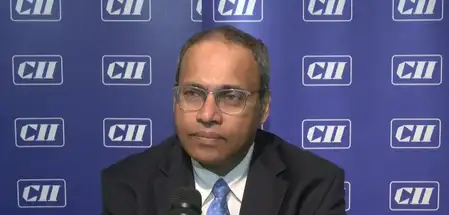
Mumbai, June 23 (IANS). Confederation of Indian Industry (CII) President R. Mukundan on Tuesday said India will have to become more competitive globally to achieve the goal of becoming a $10 trillion economy. He said that amidst the changing geopolitical and technological scenario, India will have to increase its pace in the fields of trade, manufacturing, investment and innovation. In an exclusive conversation with news agency IANS, Mukundan expressed his views on many important issues like economic reforms, FDI, Free Trade Agreements (FTA), green development, Artificial Intelligence (AI) and energy security.
Speaking to IANS, the CII President said that India has made significant progress in many areas in the last 12 years. He said that major improvements have been seen in sectors like electricity, logistics, railways, ports and shipping. However, India will have to outperform countries like China and Vietnam to become a global manufacturing hub. He said that now there is a need to pay special attention not only to ‘ease of doing business’ but also to ‘speed of doing business’.
On the issue of foreign direct investment (FDI), Mukundan said Indian companies are investing abroad, but more reforms are needed to attract more foreign investment in India. He says that by making the investment process simpler and faster, more capital can be brought into the country.
Speaking on India-US Free Trade Agreement (FTA), he said that India has signed many FTAs, but they are not being utilized at the expected level. He stressed the need to increase ‘Free Trade Utilization’ (FTU). According to him, there are huge opportunities for cooperation between India and America in areas like defence, aerospace and advanced manufacturing.
On the aim of making India a $10 trillion economy, Mukundan said the country will have to massively increase the capacity of shipping, ports and railways. Also, there is a need to increase efficiency by digitalizing many government and industrial processes. He believes that only strong infrastructure will become the foundation of rapid economic growth.
Regarding the Production Based Incentive (PLI) Scheme, he said that this scheme has been very successful in the electronics sector and has yielded positive results. However, PLI schemes should also be expanded to furniture, toy industries and other labour-intensive sectors, so as to further boost domestic manufacturing.
On green policy and energy transition, Mukundan said that it takes time to develop electricity transmission network, hence more attention has to be paid to strengthening the distribution system. He said that the industry has given many suggestions to the government in this regard and work on these is also going on.
The CII President further said that Artificial Intelligence (AI) technology is still in its early stages, but it needs to be used on a wider scale. He said that productivity and service quality can be improved by effectively using AI in health services, education, infrastructure and administrative functions.
On ethanol blending, Mukundan said that strengthening energy security should be the priority of the country. He said that ethanol blending does not have any negative effect on vehicles manufactured after the year 2020. He also expressed the need to bring better vehicle scrappage policy and incentive schemes, so that the use of clean fuel can be promoted.
On the question of water use in ethanol production, he told IANS that India needs to learn from Israel in the field of water management. Referring to the ‘Per Drop More Crop’ campaign launched by Prime Minister Narendra Modi when he was the Chief Minister of Gujarat, he said that the agriculture sector can be made more sustainable by better conserving water and promoting crops with less water use.
Regarding the ongoing geopolitical tension in West Asia and its impact on inflation, Mukundan said that the government and the industry together have prevented the burden of rising costs from reaching consumers in most areas. However, impact has been seen in some areas. He said that there is a big difference in the cost of electricity in different states and attention has to be paid to measures to reduce this cost, so that the competitiveness of industries can be increased.
Mukundan further said that India has a strong demographic advantage, a growing domestic market and a rapidly growing tech ecosystem. If there is continued focus on infrastructure, investment, digitalisation, green energy and innovation, India can achieve an even stronger position in the global economy in the years to come.
–IANS
DBP