
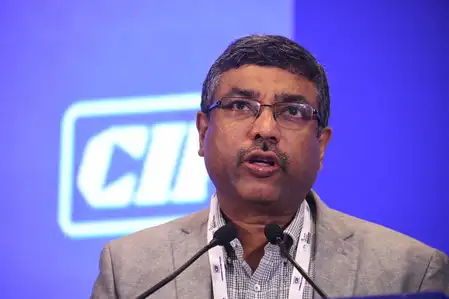
New Delhi, July 19 (IANS). Electronics and Information Technology Secretary S. Krishnan said India is developing a balanced and carefully designed regulatory framework for Artificial Intelligence (AI), which aims to maintain a balance between necessary safeguards and innovation. For this, the evolving regulatory approaches being adopted by the US, European Union (EU) and other international forums are also being studied.
AI capabilities are increasing rapidly around the world. In such a situation, governments of various countries are considering ways to regulate powerful AI models, so that technological progress is not hindered.
India is also expanding its AI ecosystem through the IndiaAI Mission, strengthening public computing infrastructure and encouraging indigenous AI development.
Speaking to NDTV Profit, Krishnan said that now there is a global consensus that AI cannot be left completely without any regulation.
He said, “There is a global perception that regulation is necessary for AI. Earlier, the US was the most vocal opponent of AI regulation, but now it is controlling access to some cutting-edge (frontier) AI models. This clearly shows how thinking on this topic has changed.”
Krishnan said India is deeply studying the AI governance models being adopted by various countries and regions, so that the country’s regulatory framework can be made practical, balanced and in line with future needs.
He said, “Our response must be a balanced and thoughtfully designed set of rules. It is important to have the necessary safeguards and guidelines for AI platforms, but at the same time the rules should not be such that they stifle innovation.”
He admitted that making laws related to AI is not easy, because this technology is developing very fast.
“The law will have to keep pace with the pace of technology. It is a very delicate balance and creating such a framework is challenging. It will take some time,” he said.
Electronics and IT Secretary said that India is actively participating in the global discussion related to AI governance. This also includes conversations with the EU and US-led Pax Silica initiative, where topics such as AI infrastructure, access to computing resources and responsible AI development are being discussed.
“We are part of various global forums working on these issues. We have had discussions with a number of countries and groups, including the European Union and Pax Silica, on what the regulatory framework for AI should be,” he said.
The government has already clarified that India will neither copy the EU’s comprehensive AI Act nor adopt the relatively light regulatory model initially adopted by the US.
Instead, policymakers are working to create a framework that addresses potential risks associated with cutting-edge AI models, while also ensuring adequate flexibility for startups, research institutions, and innovation-based enterprises.
–IANS
abs