
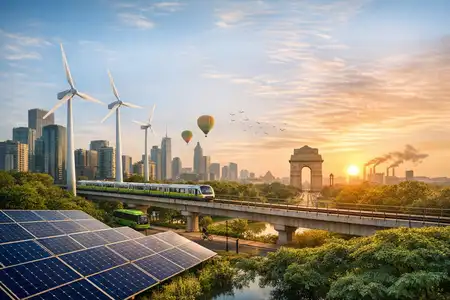
New Delhi, April 24 (IANS). India and South Korea have taken a big step to advance climate cooperation at the global level. Both countries have signed a bilateral agreement under Article 6.2 of the Paris Agreement.
The agreement was signed during the visit of the South Korean President to India and paves the way for the creation of a cross-border carbon market between the two major Asian countries.
It is also part of a number of other agreements, including clean energy, trade and industry partnerships. This clearly shows that both the countries want to take care of the environment along with economic development.
In fact, this system of Article 6.2 allows countries to work together on pollution reduction projects and exchange carbon credits. This makes it easier to achieve climate-related goals at less cost.
Whatever emissions are reduced under this system is called ITMO (Internationally Transferred Mitigation Outcome). One ITMO means the reduction of one tonne of carbon dioxide or its equivalent gas. With this, countries can add to their target by investing in projects in other countries.
The report says that there is also an important rule in it, which is called ‘Corresponding Adjustment’. This means that the same emissions reduction will not be counted twice, keeping the entire system clean and transparent.
Currently, interest in the carbon market is increasing rapidly around the world. This system is still in its initial stages, but many countries have already made such agreements and work on many projects is going on.
These are now seen as essential tools that can help countries achieve their climate goals at a lower cost.
This partnership also fits with the long-term climate goals of both countries. India has set a target of achieving net-zero by 2070, while South Korea wants to achieve this target by 2050.
This partnership becomes beneficial because the timelines of both are different. South Korea, which has limited options to reduce emissions at home, could invest in cheaper projects in other countries. At the same time, India can get funding for such projects, so that it can move forward rapidly in the direction of clean energy.
–IANS
AY/ABM