
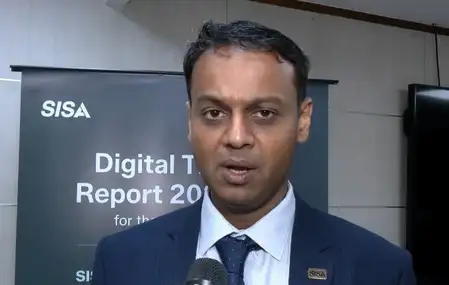
New Delhi, July 13 (IANS). The ‘Digital Threat Report 2025-26: From Frontline Intelligence to Collective Foresight’ was released as part of a government-private partnership aimed at strengthening the cyber security of the banking, financial services and insurance (BFSI) sector. On this occasion, cyber security experts said that India is no longer limited to the security of its digital ecosystem only, but is also playing an important role in global cyber security. The report provides practical and effective suggestions to organizations to deal with the growing cyber threats in the era of Artificial Intelligence (AI).
Darshan Shantamurthy, Founder and Chief Executive Officer (CEO) of SISA, while talking to news agency IANS, said that this Digital Threat Report is an important document not only for India but for the entire world. He said that today India handles about 49 percent of the world’s real-time digital payment transactions, which is the result of India’s strong and trusted digital payments ecosystem.
He told IANS that the Government of India and CISA have jointly prepared this report so that the industry and the global community can further strengthen cyber security. He said that this report has been prepared keeping in mind the future threats and will help the institutions to be prepared in advance.
Darshan Shantamurthy further said that this day is an important milestone for the partnership between the government and the private sector. He said that this is the second digital threat report released under this partnership. The first report received an overwhelming response from across the world. It was downloaded more than 20,000 times and around 350 briefing sessions were held with various industries.
He said, “The aim of this initiative is not just to respond after cyber attacks, but to make institutions safer by increasing awareness in advance. India, which makes the largest number of digital payments in the world, has the responsibility not only to protect its systems, but also to contribute to global cyber security.”
Darshan Shantamurthy explained that the report specifically analyzes AI-based cyber threats that have increased rapidly in the last 6 months. It explains in detail what steps institutions should take to avoid cyber attacks. The report not only identifies risks, but also makes practical and implementable recommendations to address them.
At the same time, Dr. Sanjay Bahl, Director General of Indian Computer Emergency Response Team (CERT-In) told IANS that this is the second edition of the Digital Threat Report. He said that in the first report, seven such areas were identified where cyber threats were expected to increase. Now threats and risks have increased markedly in six of those areas.
He said that the risks related to quantum technology alone have not yet fully emerged, but they are also likely to increase in the next one or two years. Cyber risks appear to be increasing rapidly in all other sectors.
Dr. Sanjay Bahl told IANS, “The government is continuously working to control digital fraud and cyber crimes, but citizens and institutions also have to be aware of cyber security. Along with the changing technology, it is necessary to continuously strengthen the security measures.”
On the question of impact of AI on jobs, Dr. Bahl said that history shows that such apprehensions arise with the advent of every new technology. Even when Information Technology (IT) came, people were afraid of losing their jobs, but it did not happen.
He said that in the era of AI, the most important thing is re-skilling and preparing oneself according to new technologies. For those who learn new skills over time, both employment and opportunities will increase. AI needs to be viewed as an opportunity rather than a threat.
Dr. Bahl further said that India has taken another important step in the field of cyber security by issuing several important guidelines including the AI Bill of Materials. These include Software Bill of Materials, Hardware Bill of Materials, Crypto Bill of Materials, Quantum Bill of Materials and AI Bill of Materials.
He said that till now only Software Bill of Materials had been worked on in the world, but for the first time India has prepared comprehensive guidelines for many emerging technologies including AI. This will help in strengthening cyber security in future.
–IANS
DBP