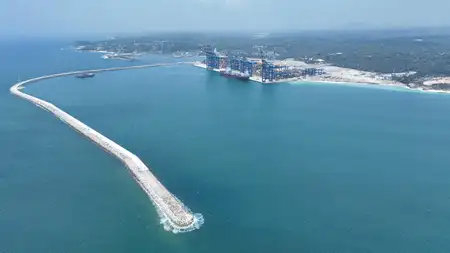
New Delhi, December 28 (IANS). India is moving rapidly towards becoming a strong maritime power. This is no longer just a long-term goal, but is now clearly visible along the country’s 7,500 km long coastline.
According to a report by India Narrative, ports, which were earlier just small trade hubs, have now become major economic hubs, handling more cargo and strengthening India’s manufacturing, exports and global competitiveness.
As port activity continues to expand, an important question has emerged – how can development continue without damaging the marine environment and exacerbating climate change?
India has made its answer even more clear. The government now believes that green development is not an obstacle, but is the only path to long-term sustainable development.
According to the report, about 95 percent of India’s foreign trade in terms of volume goes through ports. Therefore ports are very important for the country’s economy.
Cargo movement at major ports has increased significantly over the last 10 years, from about 581 million tonnes to about 855 million tonnes. This growth reflects strong manufacturing and connectivity to the global supply chain.
On the other hand, ports are also major sources of air pollution, water pollution and carbon emissions. Many ports are located near mangrove forests, swampy areas, coral reefs and densely populated coastal cities.
A major change is already taking place in this direction. The Indian Ports Act, 2025 has been implemented in place of the old Ports Act of 1908, which is considered an important turning point in maritime administration.
Now environmental protection has been made a part of the law. Sustainable development is no longer an option but a necessary condition. Along with this, the development of ports has been linked to climate responsibility.
The center of this thinking is ‘Maritime India Vision 2030’, in which environmental protection has been kept of utmost importance along with the development of ports. This is also supported by the ‘Green Sea Green Port Guidelines’, which set clear and measurable targets.
According to these targets, ports will have to reduce carbon emissions per tonne of cargo by 30 percent by 2030. Also, a large amount of machines will have to be run on electricity and more than 60 percent of the energy will have to come from renewable sources.
These targets will be extended further till 2047, making it clear that the green transition is not a one-time task, but an ongoing process.
The day-to-day functioning of ports is also being improved. The ‘Shore-to-Ship Power System’ allows ships to switch off their diesel engines while docked in port, thereby reducing air pollution in nearby cities.
Electric cranes, vehicles and lifting machines reduce noise, save fuel and increase worker safety.
These changes will directly benefit the local people who have been suffering the effects of port pollution for a long time.
Water management and biodiversity conservation are also becoming priorities. New techniques include reusing waste water, releasing it outside in small quantities and reusing excavated materials for various purposes.
Regrowing and greening mangrove forests can help sequester carbon and protect coasts from storms and erosion, which are becoming more frequent due to climate change.
–IANS
DBP/ABM