
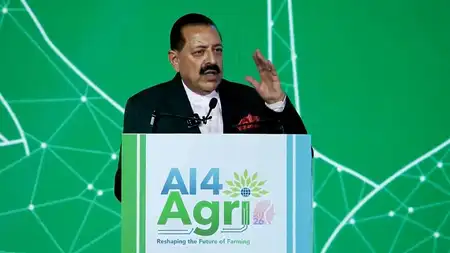
New Delhi, February 22 (IANS). India’s next agricultural revolution will be driven by Artificial Intelligence, Dr Jitendra Singh, Minister of Science and Technology and Earth Sciences, said at the AI4 Agri 2026 Summit held in Mumbai today. He described AI as a central pillar of the farming policy, research and investment framework. Addressing the inaugural session of the “Global Conference on AI in Agriculture and Investor Summit 2026” held here, the Minister said AI offers for the first time large-scale implementable solutions to the structural challenges that have long been limiting farming productivity – erratic weather, information asymmetry and fragmented markets.
“What AI offers is not a new diagnosis; it is ultimately a treatment that can be implemented at scale across the country,” he said. He also noted that even for the approximately 600 million farmers in the Global South, even if productivity increased by just 10 percent, this would be what he said would be the greatest poverty-reduction opportunity of this century.
Positioning agriculture as a strategic sector rather than an old, traditional sector, Dr Jitendra Singh linked this AI‑effort to the Rs 10,372 crore India AI Mission, which is building indigenous supercomputing capacity, datasets and startup infrastructure on a large scale.
He discussed Bharatjan – India’s large government-owned language model ecosystem – which has already released a sector-specific farming model called “Agri Param” that works in 22 Indian languages and gives farmers access to advisory support in their mother tongue. “This is AI that talks to the farmer in Marathi, Bhojpuri, or Kannada,” he said, and stressed the importance of linguistic inclusion. The Minister informed that the Department of Science and Technology (DST) is supporting India AI Open Stack, which is an open, interoperable framework, so that Agri‑AI solutions developed in any part of the country can be easily integrated into the national framework.
Research The National Research Foundation in collaboration with IITs, IICs and ICAR is funding deep‑tech and AI research, including agricultural applications. Dr Singh pointed to drones and satellite‑based mapping, which are already strengthening the Soil Health Card and Swamivit missions, as they provide verified data of land and soil. He talked about investments in climate intelligence, where earth sciences and AI are being integrated into early warning systems so that farmers “do not panic, but plan.” He said the role of biotechnology will be vital in the development of sustainable and disease-resistant crops, including early, symptom-free detection of pests and plant diseases, and will also contribute significantly to the advancement of a circular crop economy.
Highlighting the scale of the possibilities, Dr Jitendra Singh said India’s nearly 14 crore farming units, most of which are small and marginal farmers, could together generate value of around Rs 70,000 crore annually, if AI-driven advice saved each farmer even just Rs 5,000 per year through better investment timing, pest prediction and market linkages. He announced Maharashtra’s Rs 500 crore MahaAgri-AI
Cited the Policy 2025–29 as a role model and said the Center will coordinate and promote such state‑level initiatives.
–IANS
ms/