
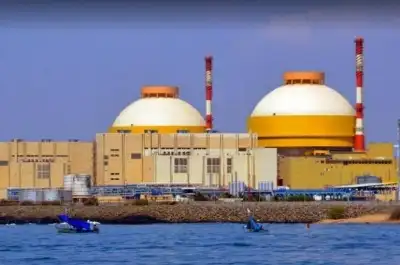
New Delhi, May 29 (IANS). According to an article published in Geopolitical Monitor, India’s rapidly growing civil nuclear energy program provides an opportunity to strengthen strategic cooperation between India and Central Asian countries. It emphasizes the possibilities of long-term partnership in uranium supply, strengthening energy security, expansion of economic ties and geopolitical diversification.
A deal worth more than $4 billion has been signed between Kazakhstan’s national nuclear company Kazatomprom and India’s Department of Atomic Energy for the supply of uranium for 2026. This shows that India-Central Asia cooperation in this domain is moving from commodity trade to a strategic implementation.
The article emphasizes that as India seeks to expand civilian nuclear energy generation and diversify fuel supply, Kazakhstan and Uzbekistan are becoming essential partners in a larger Eurasian resource architecture. For Astana and Tashkent, India is not a transactional buyer but a long-term partnership based on multi-year contracts and shared interest in continental connectivity.
India has set a target of 100 GW of civilian nuclear capacity by 2047, and an interim target of 22,480 MW by 2031-32. Small modular reactors are being given separate attention. More than $2 billion has been reserved in this direction in the Budget 2025/26 and the Rs 200 billion Nuclear Energy Mission aims to build at least five country-designed small modular reactors by 2033.
In this background, Kazakhstan looks almost an ideal partner for India. This republic has about 14 percent of the global uranium reserves and remains the world’s largest uranium producer. In 2025, Kazakhstan’s total uranium production is expected to reach 25,800 tonnes, including 13,500 tonnes from Kazatomprom, supplying about 20 percent of global primary uranium output.
The report said that such a partner holds strategic importance for India, which is planning to rapidly increase civilian nuclear energy generation.
The Kazakhstan-Indian uranium partnership already has considerable institutional depth. Kazakhstan was earlier one of the important uranium suppliers to India along with Canada. The 2026 agreement transforms this relationship from the category of routine commodity cooperation to a long-term strategic connection.
For New Delhi, the deal strengthens the Kazakhstani uranium fuel base and reduces dependence on a single supplier at a time when the country plans to rapidly expand civilian nuclear energy generation. For Astana, the scope in the Indian market increases against the backdrop of China’s strong presence in extraction, logistics and raw material processing in Central Asia.
According to the report, Chinese companies are already strengthening their place in Kazakhstan’s big uranium projects. Buying assets from Rosatom of Russia. In this situation, India becomes another stable partner in the uranium market. For Kazakhstan, this format is especially valuable.
But, the main obstacle is geography. Without reliable routes through the Caspian, Iran or Afghanistan, uranium diplomacy will face the same connectivity problems that have limited India’s presence in the region for decades. According to the article, the main question is whether nuclear fuel can become the medium through which India can maintain its strong hold in Central Asia.
Transport risks do not eliminate hopes for cooperation between India-Kazakhstan-Uzbekistan. They make it more political. The issue extends beyond the sale of raw materials to building reliable routes, supply insurance and long-term arrangements.
–IANS
KK/ABM