
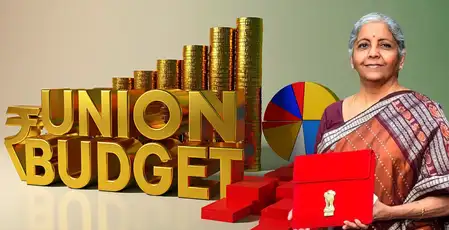
New Delhi, January 26 (IANS). As the time of presentation of Union Budget 2026-27 approaches, a clear change is visible in the thinking of the industry. Now companies are paying more attention to the direction, continuity and proper implementation of policies rather than big announcements. This information has come out in a survey on Monday.
According to Grant Thornton India’s ‘Pre-Budget Survey 2026’, Budget 2026 is being considered an indication of India’s medium-term economic thinking amid rising uncertainty in the world and the government’s plan to gradually reduce the fiscal deficit. The government aims to bring the deficit down to around 4.4 percent of GDP.
It is estimated that India’s economy will grow at the rate of 6.5 to 7 percent in the financial year 2026. The capital expenditure of the central government has now been more than three times compared to financial year 2020. In such a situation, companies want stable policies, practical incentives and easy procedures for long-term decisions, not small and temporary measures.
According to the survey, the industry is in favor of a balanced strategy. About 35 percent people believe that growth and employment should be given priority, even if the pace of deficit reduction is a little slow.
Whereas 28 percent people want a balance between deficit control and development spending. Apart from this, 26 percent people have emphasized on strict financial discipline to maintain the confidence of investors.
On the trade front, a simple and reliable export promotion system has been considered most important. It got the support of 40 percent people. After this, 31 percent insisted on completing free trade agreements (FTAs) with major countries.
Companies want less hassle during the transition to the new income tax law. 28 percent people want more time with relaxation in penalty. 26 percent are demanding special support centres, while 25 percent are pushing for direct dialogue between the industry and the government.
For salaried taxpayers, 44 percent believe that lower tax rates or higher tax slabs could make the new tax regime attractive. Whereas 26 percent are demanding limited cuts.
The survey said that innovation fund and tax exemption on research and development were considered the most effective measures. This reduces both expenses and risks on new technology. Besides, government-private partnership has also been said to be necessary.
Clarity and trust are considered most important for long-term investment. About 41 percent people have demanded a stable tax regime for Invitational Investments (Invits), REITs and infrastructure bonds.
After this, 23 percent stressed on tax clarity in PPP projects and 19 percent stressed on simplifying the approval process of foreign funding.
Renewable energy and energy storage were cited as the biggest priority by 43 percent. This was followed by urban infrastructure (26 percent) and transport and logistics (21 percent).
40 percent of the industries considered simplification of licenses and rules as most important, while 33 percent want government services to be completed within the stipulated time.
The survey said that quick resolution of tax disputes is important, but what is even more important is clear rules and easy procedures.
Richa Sawhney, tax partner, Grant Thornton India, said that companies want clarity and stability in every area of tax, trade and customs, so that work can proceed without hindrance.
In the case of customs, rules as per international standards and low duty on essential raw materials have been said to be the most effective measures. Besides, the need for a clear plan of duty has also been mentioned.
–IANS
DBP/VC