
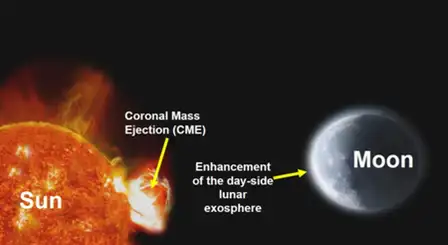
Bengaluru, October 18 (IANS). India’s Chandrayaan-2 mission has surprised space scientists around the world by revealing a scientific mystery. According to the Indian Space Research Organization (ISRO), Chandrayaan-2 recorded for the first time that the energy of the Coronal Mass Ejection (CME) from the Sun directly affects the Moon’s atmosphere.
In a historic scientific breakthrough, the Indian Space Research Organization (ISRO) has announced that its Chandrayaan-2 has for the first time observed the effects of a coronal mass ejection (CME) from the Sun on the Moon’s exosphere.
The observations were made using the Chandra Atmospheric Composition Explorer-2 (CHACE-2) instrument onboard the orbiter. During a rare solar event on May 10, 2024, several CMEs impacted the Moon, causing a significant increase in the total pressure of the extremely thin atmosphere surrounding the Moon—the daytime lunar exosphere.
ISRO scientists reported that the density of neutral atoms and molecules in the exosphere increased by more than an order of magnitude, confirming theoretical predictions that had never before been verified through direct observation.
The Moon’s exosphere, classified as a surface boundary exosphere, is highly sensitive to solar activity due to the absence of a global magnetic field. The CME event increased the release of atoms from the lunar surface, temporarily altering the Moon’s atmospheric conditions.
ISRO said these findings not only deepen the scientific understanding of lunar space weather, but also have implications for the design of future lunar missions and human habitats on the Moon. The study, titled ‘Impact of coronal mass ejection on lunar exosphere observed by CHACE-2 on Chandrayaan-2 orbiter’, was published in Geophysical Research Letters on August 16, 2025.
ISRO said, “Earth’s Moon has a very thin atmosphere, which falls in the category of ‘exosphere’, which means that gas atoms and molecules in the lunar atmosphere rarely interact despite their co-existence. The boundary of the exosphere is the surface of the Moon and hence the Moon’s exosphere falls in the category of ‘surface boundary exosphere’.”
It states that the exosphere on the Moon arises from several processes, including the interplay of solar radiation, solar wind (hydrogen, helium, and a small amount of heavy ions emitted from the Sun), and meteorite impacts on the Moon’s surface. These processes release atoms/molecules from the Moon’s surface, which become part of the exosphere.
ISRO said, “In general, the Moon’s exosphere is highly sensitive to even small changes in the factors responsible for its formation, and one such factor is coronal mass ejections from the Sun, called CMEs (short for coronal mass ejections). CMEs are events when the Sun ejects significant amounts of its formation material, mostly helium and hydrogen ions. These effects are important on the Moon, because the Moon is an airless body, and also devoid of any global magnetic field, the presence of which could block (albeit partially) solar impacts on its surface.”
It said this opportunity to directly observe the impact of a CME on the Moon came as a rare event on May 10, 2024, when a series of coronal mass ejections (CMEs) were launched by the Sun. This increased amount of solar coronal mass falling on the Moon enhanced the process of stripping atoms from the lunar surface, releasing them into the lunar exosphere, which manifested as an increase in the total pressure in the sunlit lunar exosphere.
— IANS
MS/DKP