
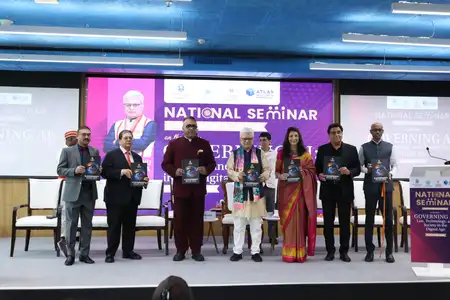
Mumbai, April 27 (IANS). Maharashtra Governor Jishnu Dev Verma met O.P. in Mumbai. Jindal Global University (JGU) released its AI Governance Report 2026.
Verma said, “I congratulate the Cyril Shroff Center for AI, Law and Regulation at O.P. Jindal Global University, where members of the industry and public institutions have come together in a spirit of shared values. Convenors like this show how innovation and partnerships can bring impactful solutions.”
He said, “Today we are talking about AI in governance and I would like to emphasize on the importance of it when we bring about change. This is the era of research and we are moving towards a developed India, which cannot be defined only in economic terms. AI will solve a lot of problems, but it also comes with challenges. We have to use AI with compassion, to deliver services to the last person and for the upliftment of the masses. It becomes even more important to protect values because purposeless technology is dangerous. This concept comes from the ancient Vedas, which talk about happiness, peace and upliftment of all. It is especially important to protect Indian art, culture and ideologies as it is a part of our national identity.
Higher education institutions around the world are undergoing structural changes in response to the rapid integration of AI and changing student expectations. AI tools enable the analysis of complex data sets, modeling of social phenomena, strengthening qualitative research, and drawing useful conclusions in the public interest. At the institutional level, AI is being incorporated into governance in a way that strengthens transparency, efficiency and evidence-based decision-making.
In her welcome address, Dr. Indu Shahani, President, Atlas Skilltech University, said, “This distinguished gathering adds to the significance of this symposium and your journeys are extremely inspiring.”
Addressing the Governor, Dr Shahani said, “There are very few leaders who combine governance, creativity and poetry. I also thank O.P. Jindal Global University for the meaningful and strategic partnerships it has forged. At Atlas Skilltech University, we combine design, management, technology, entrepreneurship and law to produce future-ready graduates.”
In his opening address, O.P. Founder Vice Chancellor of Jindal Global University, Prof. (Dr.) C. Raj Kumar said, “This report is driven by a central question: How should JGU develop an education system that uses AI to genuinely enhance learning, research and institutional efficiency, while keeping human decision-making, creativity and freedom at the heart of the educational experience? The university must stand at the forefront of knowledge, becoming principled creators and not passive spectators of change. AI is one of the most significant developments in the contemporary history of higher education. Its impact will only extend as far as technological advancements.” For JGU, engaging with AI is not limited to but a matter of intellectual leadership and normative responsibility. “The AI Governance Report 2026 offers a clear and forward-looking framework for incorporating AI into our academic, research and administrative spheres.”
Contemporary research supports active learning methods over purely lecture-based learning. Dr. Raj Kumar said, “JGU should gradually incorporate experiential learning across various disciplines, including law, business, engineering, public policy and international relations. Structured simulations, interdisciplinary capstone projects and immersive learning environments can bridge the gap between theoretical knowledge and practical proficiency. Such reforms will align JGU with Education 4.0 principles, enabling graduates to acquire not only conceptual understanding but also practical and contextual skills relevant to complex global challenges.” Will do.”
The Cyril Shroff Center for AI, Law and Regulation focuses on the idea that sustainable change cannot be achieved through policy directives alone; it requires cultural change. By embedding digital transformation within governance structures and institutional identity, JGU can move beyond incremental change to active leadership in higher education reform. Such a culture inspires teachers and students to see technology not just as a tool, but as a new medium for knowledge creation. It also strengthens the university’s ability to respond rapidly to global educational and technological changes.
Other prominent guests at the report launch event included Cyril Shroff, Managing Partner, Cyril Amarchand Mangaldas and Ronnie Screwvala, Co-Founder and Chairman, UpGrad.
During this it was also discussed that immersive technologies like Augmented Reality, Virtual Reality, Digital Twins and AI-enabled tutoring systems are the next big phase of higher education. Higher education institutions should implement such technologies in a phased manner in select programs where experiential learning has greater importance. Its implementation should be based on cost-effectiveness, accessibility, inclusivity and measurable impact of learning. Strategic partnerships with technology providers and global institutions can accelerate knowledge transfer and adoption of best practices.
The report launch was followed by a panel discussion on the topic ‘Governing AI: Law, Technology and Society in the Digital Age’. These include Paridhi Adani (Partner, Head-Ahmedabad, Cyril Amarchand Mangaldas), Gaurav Bansal (Founder and Principal Counsel, Equilibria Law Chambers), Adheesh Nargolkar (Partner, Khaitan & Co), Aparajita Rana (Partner, AZB & Partners), Richa Roy (Partner, Cyril Amarchand Mangaldas), Anushree Saha (General Counsel & Company Secretary, Cure.AI), Siddharth Shahani (Executive President, Atlas Skilltech University). It was operated by Prof. (Dr.) C. Raj Kumar did it.
–IANS
dsc