
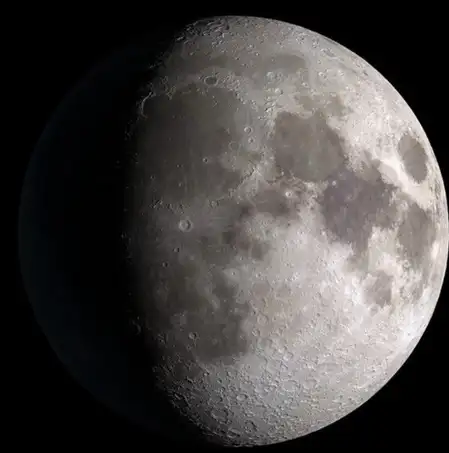
New Delhi, May 30 (IANS). On May 31, a beautiful sight of Purnima i.e. full moon will be seen in the sky. The Moon has always been a subject of fascination and curiosity for people. Its brightness, changes in shape and craters visible on the surface often raise many questions in the minds of people. One of the most common questions is that why are so many craters visible on the Moon, whereas very few such craters are visible on Earth?
If you look at the Moon, thousands of craters on its surface can be easily seen. Seeing these craters on the Moon, the question often arises that why are there so many craters on the Moon, whereas there are only about 180 known craters on Earth? In such a situation, scientists say that the biggest reason for the abundance of craters on the Moon is that there is no atmosphere there. Both the Earth and the Moon have been victims of meteorite and asteroid attacks in space for the last 4.5 billion years. But the Earth erases these marks, while the Moon preserves them for centuries.
Why does the Earth erode craters? Three major processes on Earth destroy craters almost completely. First process – Erosion, in this the wind, rain, rivers, sea and trees and plants work continuously on the earth. Together they keep breaking and wearing away the rocks. With time any pothole gradually fills up or disappears completely. At the same time, there is no atmosphere on the Moon, hence there is no air, no water and no weather. Once a meteorite hits, its mark remains the same for millions and millions of years. This is why the footprints of astronauts on the Moon are still intact.
The second process is plate tectonics, in which the Earth’s surface constantly moves and new rocks are formed, while old rocks are pushed inside. Because of this, old pits get buried or destroyed. There is no such activity on the Moon. The surface there has been stable for billions of years, so the craters remain intact.
The third process is volcanic activity. Volcanoes on Earth spew out lava and cover many craters. The Moon also had active volcanoes long ago, covering some large craters, but there has been no volcanic activity there for the past three billion years.
–IANS
mt/pm