
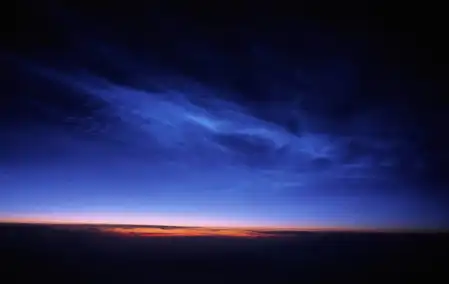
New Delhi, February 22 (IANS). The world of science is full of countless mysteries, which arouse curiosity and sometimes even surprise. One special mystery among these is the noctilucent cloud, which is also called ‘clouds that glow at night’. These clouds are completely different from normal clouds and appear glowing even in the darkness of night. American space agency NASA gives detailed information about them.
Noctilucent clouds are formed from tiny ice crystals in the upper atmosphere and create a glow by reflecting light even after the sun sets. This is a unique and mysterious phenomenon occurring in the uppermost layer of the Earth’s atmosphere. These clouds are very different from normal clouds because they form in the mesosphere at altitudes of about 50 to 86 kilometers (30 to 54 mi), far above the Earth’s surface. Their name comes from the Latin word “noctilucent”, which means ‘shining at night’.
According to NASA, these clouds are made of very small crystals of ice or water vapor. These crystals reflect sunlight, so they appear to shine even after the sun sets. During the day they are very faint and invisible, but at dusk, when the lower atmosphere is in darkness but the upper layers are still exposed to sunlight, they appear to glow iridescent blue-silver. These appear primarily in the summer months at high latitudes near the northern and southern polar regions.
These clouds remained a puzzle for scientists for a long time. NASA’s Aeronomy of Ice and the Mesosphere (AIM) mission began its first study in 2007. AIM was the world’s first satellite specifically designed to study these clouds. On June 11, 2007, AIM captured the first complete view of these clouds in the Northern Hemisphere, with approximately 5 km resolution.
AIM’s initial observations showed that these clouds appear daily, are widespread, and change from hour to hour. Their brightness varies on a scale of 3 kilometers. Scientists were surprised to find that a single, continuous layer of ice in the mesosphere extends 82 to 89 kilometers up.
By the end of 2007, AIM recorded the entire life cycle of these clouds in the Northern Hemisphere – starting around May 25 and lasting through the end of August. Over the last two decades, these clouds have become brighter and are visible even at lower latitudes.
Recent studies have also shown that increasing methane emissions create additional water vapor in the mesosphere, which strengthens these clouds.
–IANS
MT/AS