
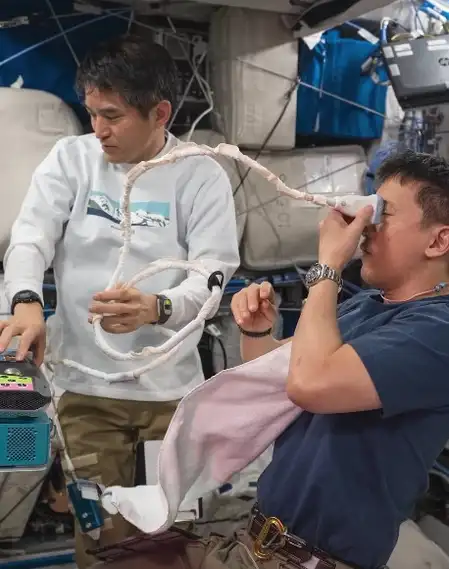
New Delhi, June 14 (IANS). The health related problems of astronauts who travel long distances in space do not end soon. Staying away from the earth for a long time not only affects the muscles and bones of the body, but also affects the health of the eyes and brain.
American space agency NASA is working on this topic so that astronauts going to the Moon, Mars and other space missions in the future can get better health protection.
NASA’s Johnson Space Center said in information posted on social media that due to the condition of weightlessness in space, the balance of body fluids changes. Due to the effect of gravity on Earth, body fluids remain downwards, but this does not happen in space. This can cause blood, spinal fluid, and other fluids to move toward the head, causing increased pressure around the eyes and brain.
According to scientists, swelling in the back of the eyes has been seen in 70 percent of the astronauts living on the International Space Station. This condition is called ‘Space Flight Associated Neuro-Ocular Syndrome’ (SANS). Due to this, the vision of some astronauts may also be affected.
However, in most cases the swelling subsides and vision improves after returning to Earth, but scientists want to know whether these changes have any long-term effects. For this purpose, NASA is running a special research program, in which the eye and brain health of astronauts will be monitored for five years after the space journey.
This study will include 20 astronauts who have completed long-term missions on the International Space Station. Along with this, 20 other members of similar age and physical structure will also be made a part of the study, so that the difference between normal aging and the effects of space travel can be understood.
During the research, the eyes of the participants will be examined in depth. This will include testing of vision, field of vision, and pressure inside the eyes. At the same time, MRI scan, neurological test, cognitive assessment and blood test will also be done to know the condition of the brain.
NASA believes that the information obtained from this study will play an important role in making future long space missions safer. This will help scientists understand what additional measures are needed to protect the health of astronauts.
–IANS
mt/pm